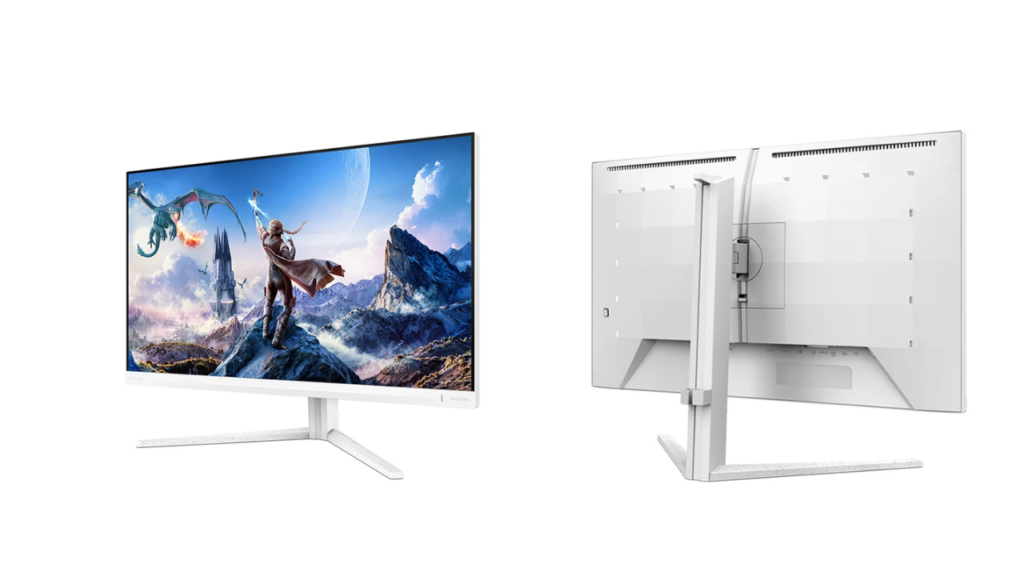
Philips has added the Evnia 27M2D5901A to its gaming lineup. It is a 27-inch IPS monitor with a dual mode, running 5K at up to 180Hz or switching to QHD at up to 350Hz. According to Philips, it goes on sale in December 2026 at an MSRP of £699. A USD price and India availability are not confirmed yet.
What Philips has announced
Dual mode means one monitor offers two resolution and refresh rate profiles. In native 5K (5120 x 2880), Philips lists 180Hz. In QHD mode, the refresh rate rises to 350Hz, aimed at competitive players who want frame rate over sharpness. AMD FreeSync Premium and Adaptive-Sync are listed.
The panel is Fast IPS with a W-LED backlight. Philips quotes a 1 ms GTG response time and a 0.5 ms MPRT figure with Smart MBR. MPRT measures perceived motion blur, and it is usually reached with a blur-reduction mode, so we expect it to apply only there.
The most unusual feature is AI-enhanced Ambiglow. According to Philips, an AI-assisted processor reads the on-screen content and adjusts the colour and brightness of three-sided ambient lighting.
Philips 27M2D5901A key specs
| Spec | Published detail |
|---|---|
| Panel | 27″ Fast IPS, W-LED, 10-bit (8-bit + FRC) |
| Native mode | 5120 x 2880 (5K), up to 180Hz, about 218 ppi |
| Competitive mode | QHD, up to 350Hz |
| Response time | 1 ms GTG, 0.5 ms MPRT |
| Brightness | 500 cd/m² |
| HDR | VESA DisplayHDR 400 |
| Static contrast | 1,000:1 |
| Colour | 98% DCI-P3, 95% Adobe RGB, 138% sRGB (gamut volume figure), Delta E < 2 |
| Sync | FreeSync Premium, Adaptive-Sync |
| Ports | USB-C (video, data, PD), 2x HDMI 2.1 (48 Gbps), 1x DisplayPort 1.4, USB hub, 3.5 mm out |
| Extras | KVM switch, PiP/PbP (MultiView), 2 x 5W speakers, 3-sided AI Ambiglow |
| Stand | 130 mm height, ±30° swivel, -5° to 20° tilt, pivot |
| Weight | 6.07 kg with stand |
| Average power use | 38.3 W (energy class E) |
| Price | £699 MSRP, from December 2026 |
| Price (USD) | Not confirmed yet |
| India availability | Not confirmed yet |
What’s new or different
The source data does not name a previous model, so a generational comparison is not confirmed yet. Here is how the published specs compare with typical categories:
| 27M2D5901A (published) | Typical 27″ QHD gaming IPS (general) | Typical 27″ 4K gaming IPS (general) | |
|---|---|---|---|
| Native resolution | 5K, about 218 ppi | QHD, lower pixel density | 4K, about 163 ppi |
| High-refresh mode | QHD at 350Hz | Often similar or lower | Usually lower at 4K |
| Mode switching | Built in | Not applicable | Sometimes |
The pitch is simple: sharper than 4K for work and slower games, and a fast QHD mode for competitive titles.
Performance in real use
These are expectations from the published specs, not test results.
Competitive gaming. The 350Hz QHD mode is the key feature. High refresh rates help most when your GPU can deliver matching frame rates. Philips lists Smart Crosshair, Smart Sniper (zoom up to 2x), Stark Shadow Boost and a low input lag mode. Stark Shadow Boost brightens dark areas without lifting the whole image.
5K gaming and desktop use. At about 218 ppi, text and fine detail should look very sharp. Running 5K at 180Hz in games takes a very powerful graphics card, and which input supports that mode is not confirmed yet.
Creative work. The 98% DCI-P3 and 95% Adobe RGB coverage are good for an IPS gaming monitor. Philips lists Delta E below 2, which is a looser colour accuracy rating than the below-1 figures some creator monitors claim. We have not verified any of it.
Movies and HDR. DisplayHDR 400 is the entry tier. With a 1,000:1 static contrast typical of IPS, we expect a modest HDR effect and no OLED-style black levels. Local dimming is not listed.
Connectivity and ergonomics
The monitor has two HDMI 2.1 ports (48 Gbps), one DisplayPort 1.4 port and a USB-C port that carries video, data and power. Philips’ announcement says up to 65W Power Delivery. The spec listing says 96W, so the figure is not confirmed yet. A USB 3.2 hub and a built-in KVM switch let one keyboard and mouse control two systems. Picture-in-Picture and Picture-by-Picture are supported.
The stand adjusts 130 mm in height, with swivel, tilt and portrait pivot. The monitor is VESA 100 x 100 mm compatible. Philips also lists a chassis made with 85% post-consumer recycled plastic, PVC- and BFR-free housing and recyclable packaging. The Evnia Precision Centre software lets users tune settings from a single interface.
Pros and cons
Pros
- Dual mode: 5K at up to 180Hz or QHD at up to 350Hz
- About 218 ppi for very sharp text and detail
- 98% DCI-P3 coverage with USB-C and KVM switching
- Two HDMI 2.1 ports, built-in speakers and a fully adjustable stand
Cons
- DisplayHDR 400 with 1,000:1 static contrast limits HDR impact
- DisplayPort 1.4 is older than DisplayPort 2.1 on some rivals
- £699 is a premium price, and USD and India pricing are not confirmed yet
- USB-C power delivery wattage is unclear (65W vs 96W in the sources)
Who should buy it, who should skip it
Buy it if you want one monitor for sharp desktop work and fast competitive games, and you have a strong GPU. Laptop users who like single-cable USB-C docking also fit.
Skip it if you care most about HDR or deep blacks, where an OLED will do better. Wait if you need a confirmed local price.
Our take
On paper, the Philips Evnia 27M2D5901A is a flexible high-pixel-density gaming monitor. The 5K panel and 350Hz QHD mode cover two jobs in one screen. HDR is basic, and key details such as USB-C wattage, input bandwidth limits and regional pricing are unclear. We would wait for independent tests of motion clarity, colour accuracy and 5K 180Hz behaviour before buying.