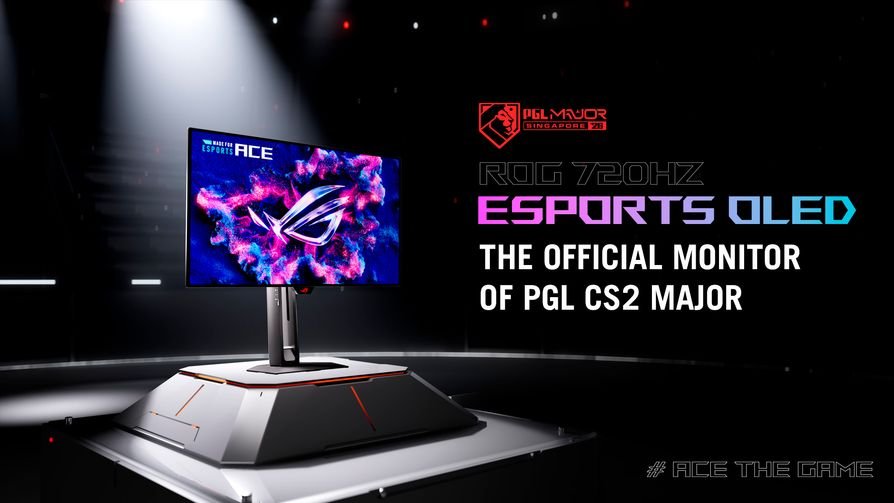
Asus Republic of Gamers has launched two 24.5-inch, 1080p OLED esports monitors for the 2026-2027 season. The ROG Swift OLED PG259QWS Ace runs at 720Hz, and the ROG Strix OLED XG259QWPG Ace runs at 540Hz. Both use LG Display’s new Tandem WOLED panel with a 0.02 ms GTG response time. They are aimed at competitive players who want OLED picture quality without giving up TN-level speed. USD price and India availability are not confirmed yet.
Key Specs
| Spec | PG259QWS Ace | XG259QWPG Ace |
|---|---|---|
| Panel | 24.5-inch Tandem WOLED (LG Display), glossy | Same |
| Resolution | 1920 x 1080, about 90 ppi | Same |
| Refresh rate | 48Hz to 720Hz | 48Hz to 540Hz |
| Response time | 0.02 ms GTG | 0.02 ms GTG |
| Brightness | 390 nits typical, 1700 nits peak | Same |
| Color | 99.5% DCI-P3, true 10-bit, Delta E < 2 (claimed) | Same |
| HDR | HDR10, Dolby Vision | HDR10, Dolby Vision, DisplayHDR 600 True Black |
| Static contrast | Not listed | 1,500,000:1 |
| Video inputs | DP 2.1 UHBR20 (80Gbps), 2 x HDMI 2.1 | DP 1.4 with DSC, 2 x HDMI 2.1 |
| USB-A | 3 | 2 |
| Average power | 36 W | 25 W |
| Weight with stand | 5.8 kg | 5.1 kg |
| Warranty | 3 years, burn-in covered | 3 years, burn-in covered |
| Price (USD) | Not confirmed yet | Not confirmed yet |
| India price | Not confirmed yet | Not confirmed yet |
Why Asus Is Pushing OLED Into Esports
For years, professional players have preferred TN panels because of their speed. According to Asus, modern OLED can now match or beat that motion handling while adding deeper contrast, richer color and wider viewing angles. The 178-degree viewing angles are confirmed in the spec sheets.
Asus lists Extreme Low Motion Blur (ELMB) and per-pixel lighting to improve clarity in fast scenes. On paper, a 0.02 ms response time (how quickly a pixel changes shade) is far below what LCD panels can reach. We have not tested either monitor, so real-world motion clarity is still to be verified.
Tandem WOLED: The Burn-In Answer
Both monitors use LG Display’s TrueBlack Glossy Tandem WOLED panel. According to Asus, the design stacks two light-emitting layers. The company claims up to 31% higher brightness, 34% greater color volume and up to 63% longer lifespan than conventional WOLED. These are manufacturer figures, and no independent data exists yet.
Longevity is the claim that matters most, because burn-in is the main reason many pros avoided OLED. Asus adds OLED Care Pro, a Neo Proximity Sensor, a GaNFET-based power supply and a custom heatsink with a thermal design to keep temperatures down. It also offers a three-year warranty that includes burn-in coverage. Detailed warranty terms are not confirmed yet.
Features Built With Pro Players
Asus says the Ace series was developed with direct input from professional gamers.
- Setup markings: The stand and base have integrated measurement scales, so a player can recreate the same setup at another venue.
- Quick OSD: Fast access to brightness, shadow enhancement and saturation.
- Hue Optimizer and Esports Color modes: Three dedicated modes, with presets for Counter-Strike 2, PUBG and Valorant.
- Aiming and visibility tools: AI Crosshair, AI Shadow Boost and AI Sniper are listed.
- Sync support: AMD FreeSync Premium Pro and NVIDIA G-Sync Compatible.
PG259QWS Ace: The 720Hz Flagship
The PG259QWS Ace is the top model. Its 720Hz refresh rate comes with DisplayPort 2.1 UHBR20, which offers up to 80Gbps. According to Asus, this bandwidth is needed for the monitor’s maximum performance mode, so you will need a graphics card with a matching output.
Asus calls the Position Sensor an exclusive feature of this model. It shows monitor height, tilt angle and the distance between the screen and the user. Asus also says the PG259QWS was selected as the official monitor of the PGL CS2 Major Singapore 2026, which it describes as the first Counter-Strike Major played on OLED displays.
One conflict: the XG259QWPG spec sheet also lists a Position Sensor. Whether it works the same way is not confirmed yet.
XG259QWPG Ace: The 540Hz Step Up From TN
The XG259QWPG Ace shares the panel, 1700-nit peak, 0.02 ms response time and color figures, but runs at 540Hz over DisplayPort 1.4 with DSC. DSC (Display Stream Compression) squeezes the signal so it fits the cable, and most current GPUs support it.
Asus positions it as a more accessible way for TN players to move to OLED. It is also lighter at 5.1 kg and uses less power, at 25 W average. Its spec sheet adds a 1,500,000:1 static contrast figure and a DisplayHDR 600 True Black listing. These are not listed for the PG259QWS, which means “not listed”, not “not supported”.
Is 720Hz Worth It?
Our calculation, not an Asus claim: a frame lasts about 1.85 ms at 540Hz and about 1.39 ms at 720Hz. The gap is under half a millisecond per frame. To benefit, your PC must actually render frames at those rates, which only a few esports titles on very fast hardware can do. For most players, we expect the difference to be small.
Design and Ergonomics
Both monitors have a flexible stand with 155 mm height adjustment, 45-degree swivel each way, tilt from -5 to 33 degrees and a 90-degree pivot. They support 100 x 100 mm VESA mounts and have a 1/4-inch tripod socket and a Kensington lock slot. Both have two HDMI 2.1 ports. Which refresh rates work over HDMI is not confirmed yet.
The PG259QWS has a transparent rear panel and ships with DisplayPort 2.1 and HDMI 2.1 cables. The XG259QWPG lists a DisplayPort cable only.
Pros and Cons
Pros
- 0.02 ms response time targets the main speed gap between OLED and TN.
- Burn-in is covered by the three-year warranty, according to Asus.
- Stand markings and Quick OSD help players recreate setups.
- The XG259QWPG draws less power and uses a more common DisplayPort standard.
Cons
- 1080p at 24.5 inches gives softer text than 1440p screens.
- 390 nits typical brightness is modest, and the glossy coating can reflect room light.
- The PG259QWS needs a DisplayPort 2.1 GPU for its top mode.
- Price is not confirmed, and we expect a premium over LCD esports monitors.
Who Should Buy Which
PG259QWS Ace: serious competitive players with a top-end GPU who want the fastest panel and the tournament extras.
XG259QWPG Ace: players moving from a high-refresh TN or LCD screen who want OLED contrast without paying for the flagship.
Skip both if you want a bigger screen, sharper text or mostly play slower single-player games.
Our Take
On paper, these are among the most serious OLED esports monitors announced for this season. The Tandem panel and burn-in warranty address OLED’s biggest weakness, and 0.02 ms response is hard for LCD to match. For most players, we expect the XG259QWPG Ace to be the sensible pick, since 540Hz is already extreme. The 720Hz PG259QWS Ace suits pros and enthusiasts. We have not tested either monitor, and the brightness and lifespan claims remain to be verified.