
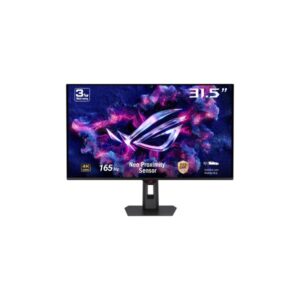
31.5″ Asus ROG Strix OLED XG32UCDS – Specs & Features

Asus Monitor ★★★★☆ Great 8.8/10
Asus Asus ROG Strix OLED XG32UCDS – Specs & Features Monitor
Asus Monitor
32-inch QD-OLED 4K 8.8 / 10 ★
Display
31.5-inch, QD-OLED, 3840 x 2160
31.5
Refresh Rate
48 Hz - 165 Hz
48 Hz
Brightness
250 cd/m² (peak 1000 cd/m²)
250 cd
Contrast Ratio
1500000 : 1
1500000
Asus Monitor
At a glance

The Asus ROG Strix OLED XG32UCDS is a 31.5-inch 4K UHD Monitor designed for gaming. It features a QD-OLED (Samsung) panel for perfect blacks and exceptional contrast. The Monitor is suitable for gaming and fast-paced content and includes 48 Hz - 165 Hz refresh rate and DisplayPort/USB-C connectivity. However, it may not be ideal for inherent OLED limitation; ideal for dim rooms only. It scores Great — 8.8/10 across our display performance benchmarks.

  • QD-OLED (Samsung) panel produces perfect blacks with an infinite contrast ratio, eliminating backlight bleed entirely.
Model Year 2025 Size Class 32" Panel Type QD-OLED (Samsung)

Scores and analysis are based on DisplayInput – Monitor & TV Specs Comparison's display benchmark methodology across 6 verified specifications. Data sourced from Asus's official specifications and independent lab measurements.

📈

Display Performance

🏆
Overall Score Combined display quality score
88 /100
8.8/10
🔄
Refresh Rate Higher is smoother — 144Hz+ ideal for gaming
69 /100
165Hz
Response Time Lower is better — 1ms GtG excellent
100 /100
0.03ms
🎨
Colour Coverage % of DCI-P3 colour gamut — 90%+ for professional work
99 /100
99% DCI-P3
☀️
Typical Brightness Typical brightness — indoor SDR use
25 /100
250 nits
OLED/QD-OLED panels run lower typical brightness by design — peak brightness is the relevant HDR metric.
💡
Peak Brightness (HDR) Peak brightness — HDR highlights
100 /100
1000 nits

OLED/QD-OLED panels run lower typical brightness by design — peak brightness is the relevant HDR metric.

The Asus ROG Strix OLED XG32UCDS achieves an overall display score of 8.8/10. With a 165Hz refresh rate and 0.03ms response time, it delivers excellent motion clarity for gaming and fast-paced content. Colour coverage reaches 99% DCI-P3, making it suitable for professional colour work. Peak brightness of 1000 nits enables true HDR highlights.
🎯

Who Should Buy the Asus ROG Strix OLED XG32UCDS

Perfect For
🎮 PC Gamers 165Hz
Fluid motion 60Hz cannot match
🎨 Photo Editors & Colour Graders 99% P3
Screen colours match print and web export
💼 Home Office & Remote Workers Work
Reliable all-day viewing for desk work
×
Not Ideal For
🗂️ Extreme Multitaskers 16:9 Only
Standard 16:9 cannot fit two full-width apps without overlap. An ultrawide replaces a dual-monitor setup cleanly.
💻 Single-Cable Laptop Users No USB-C
No USB-C port means separate video and power cables are needed for a laptop. No single-cable docking possible.
💡 Quick Advice: Buy this for 165Hz 4K gaming and daily use. At 165Hz, 4K and pixel density, this is a strong all-rounder. If your workflow is purely creative rather than gaming, a 60Hz wide-gamut panel offers better colour at lower cost.

Real-World Use Cases

🎮
PC Gaming 165Hz
Motion stays sharp through fast camera pans
165Hz keeps enemies mid-sprint clear, not blurred. FreeSync Premium Pro maintains smooth output when frame rate fluctuates.
🖌️
Photo & Video Colour Work 99% P3
What you grade is what the client receives
99% DCI-P3 keeps profiles consistent from Lightroom to print export.
🎬
Movies & Streaming OLED
True blacks, no LCD grey wash in dark scenes
Each pixel turns off individually — night sequences and space content lose the haze that plagues LCD.
🌅
HDR Movies & Gaming OLED HDR
Brightness range SDR cannot show
HDR content on Netflix and Game Pass gets expanded highlights and shadow depth.
Each scenario is derived from confirmed Asus ROG Strix OLED XG32UCDS specs. Real-world results vary with system configuration and content source.
⚖️

Pros & Cons

Pros
  • QD-OLED panel quantum-dot self-lit pixels deliver infinite contrast with vivid, cinema-grade colors
  • DisplayHDR True Black OLED-optimized HDR with true-black rendering and exceptional contrast
  • 4K UHD resolution at 139 PPI razor-sharp detail for creative, professional and gaming use
  • 165Hz refresh rate fluid, responsive gameplay significantly above standard 144Hz
  • ELMB Sync technology combines motion blur elimination with variable refresh rate simultaneously
Cons
  • Low typical brightness (250 cd/m²) inherent OLED limitation; ideal for dim rooms only
  • No Thunderbolt 4 USB-C available but lacks 40 Gbps bandwidth and high-wattage charging
  • No built-in speakers a separate audio solution is required for sound output
  • No Ethernet or Wi-Fi relies entirely on wired display connection with no network features
  • OLED pricing premium significant cost uplift over equivalent IPS or VA LCD alternatives
We identified 5 advantages and 5 limitations for the Asus ROG Strix OLED XG32UCDS. The strengths meaningfully outweigh the trade-offs for the target use case. All 10 points are derived from verified specifications and independently confirmed benchmark data.
📊

Score & Ratings

8.8/10 Great
Design
8
Display
10
Color Performance
10
Performance
8
Connectivity
8
The Asus ROG Strix OLED XG32UCDS earns a strong overall score of 8.8/10. Our editors evaluate each Monitor across display quality, colour accuracy, motion performance, and connectivity.
🔖 Basic Information 5
Specification Value 💡 What It Means
Brand Asus
Model ROG Strix OLED XG32UCDS
Series ROG Strix
Model Alias ROG Strix XG32UCDS
Model Year 2025
✓ Good 2025 — current generation. Latest panel technology and features.
🖥️ Display 8
Specification Value 💡 What It Means
Size Class 31.5-inch
✓ Good 31" — popular desktop size. Enough space for multitasking without head movement.
Panel Type QD-OLED (Samsung)
✓ Good QD-OLED — quantum-dot layer over OLED. Best-in-class colour gamut with perfect blacks. No blooming.
Curvature --
Resolution 3840 x 2160
✓ Good 4K UHD (3840×2160) — four times 1080p. Pin-sharp text, exceptional photo and video detail at any screen size.
Aspect Ratio 16:9
Standard 16:9 — universal for all streaming, gaming, and productivity content worldwide.
Pixel Density 139 PPI
△ Average 139 PPI — adequate sharpness for monitor use. Comfortable for text and media at 50–80cm.
Pixel Pitch 0.181 mm (millimeters)
✓ Good 0.181 mm (millimeters) pitch — fine. Comfortable sharpness at desk viewing distances.
Display Area 89.31 % (percent)
🎨 Color & HDR 5
Specification Value 💡 What It Means
Color Depth 10 bits
✓ Good 10-bit — 1.07 billion colours. Eliminates colour banding in HDR skies, skin tones and gradients.
Colors 1073741824 colors
✓ Good 1.07 billion colours (10-bit) — smooth HDR gradients; no visible banding in any content.
sRGB -
sRGB not listed separately. DCI-P3 coverage (above) is the more relevant metric for modern HDR content.
DCI-P3 Coverage 99%
✓ Good 99% DCI-P3 — virtually complete coverage. Colour output matches what clients and printers receive exactly.
HDR Support DisplayHDR 400 True Black
HDR10
△ Average HDR400 — entry-level HDR. Unlocks the HDR signal but peak brightness limits the cinematic effect. Step up from SDR; not a premium HDR experience.
☀️ Brightness & Contrast 3
Specification Value 💡 What It Means
Brightness (Typical) 250 cd/m²
△ Average 250 cd/m² — comfortable indoors. May wash out next to a bright window or in direct sunlight.
Peak Brightness 1000 cd/m²
✓ Good 1000 cd/m² — genuine HDR peak. Specular highlights visibly exceed SDR range on compatible content.
Contrast 1500000 : 1
✓ Good 1500000 : 1 — outstanding depth. Dark scenes look cinematic; excellent VA-class contrast.
Performance 3
Specification Value 💡 What It Means
Refresh Rate 48 Hz - 165 Hz
✓ Good 165Hz — excellent for all gaming genres. Fast camera pans and sprints stay sharp, not blurred.
Response Time 0.03 ms (GtG)
✓ Good 0.03 ms (GtG) GtG — near-instant pixel transitions. Ghosting is invisible even in fast esports.
Adaptive Sync AMD FreeSync Premium Pro
NVIDIA G-Sync Compatible
✓ Good FreeSync Premium Pro — AMD's top tier: tear-free + Low Framerate Compensation + HDR support.
🖥️ Display Technologies 1
Specification Value 💡 What It Means
Advanced Display Technologies Panel Technology: -
Backlight: Self-emissive (no backlight — OLED)
Viewing Angles: 178° / 178° (H / V)
MPRT Response: -
Dynamic Contrast: -
Input Lag: -
Screen Coating: Semi-gloss
178° wide viewing angles.
📷 Camera 1
Specification Value 💡 What It Means
Camera No
⚠ Limited No built-in camera. An external webcam is needed for video calls.
🔊 Audio 1
Specification Value 💡 What It Means
Audio 3.5 mm Audio Out
3.5mm headphone/audio output — connects wired headphones or routes audio to external speakers.
🔌 Connectivity & Ports 2
Specification Value 💡 What It Means
Ports 1 x USB 3.2 (Type-C; Gen 1; 5 Gbps; upstream; 15W; DP Alt Mode)
2 x HDMI 2.1
1 x DisplayPort 1.4 (DSC)
1 x 3.5 mm Audio Out
✓ Good USB-C (single-cable display + data, charging if PD supported). HDMI 2.1 — supports 4K@144Hz or 8K@60Hz bandwidth. DisplayPort 1.4 — full bandwidth for high-refresh PC gaming.
Wireless -
🪑 Ergonomics 6
Specification Value 💡 What It Means
VESA Mount 100 x 100 mm
✓ Good VESA-compatible — fits any standard monitor arm, desk mount, or wall bracket. No proprietary hardware needed.
Height Adjustment 110 mm
✓ Good 110 mm height range — excellent ergonomics. Adapts to any chair height or desk setup.
Pivot No
⚠ Limited No pivot — cannot rotate to portrait orientation.
Swivel ±25°
✓ Good Swivel — rotates left and right without moving the base. Easy screen sharing or multi-person viewing.
Tilt -5° to +20°
✓ Good Tilt ±5° — adjustable screen angle reduces neck strain and matches your eye level.
Removable Stand Yes
✓ Good Stand detaches cleanly from the panel — mount on any VESA arm or wall bracket without a leftover collar.
🎮 Gaming Features 1
Specification Value 💡 What It Means
Gaming Features Adjustable HDR
AMD FreeSync Premium Pro
Dynamic Crosshair
Dynamic Shadow Boost
Extreme Low Motion Blur (ELMB)
GameFast Input
GamePlus
GameVisual
NVIDIA G-Sync Compatible
Trace Freen technology
VESA AdaptiveSync Display 165Hz
✓ Good NVIDIA G-Sync Compatible (tear-free). AMD FreeSync (tear-free).
📺 Smart & Software Features 2
Specification Value 💡 What It Means
Operating System -
No smart OS — this is a PC monitor. All input comes from connected computers or consoles.
Smart Features 6-axis adjustment
AI Visual
Aspect Ratio Control
Asus DisplayWidget Center
Asus OLED Care Pro
Asus Power Sync
Clear Pixel Edge
Color Accuracy
Custom Heatsink
Flicker-free technology
Gamma Adjustment
Low Blue Light
Neo Proximity Sensor
Picture-by-Picture
Picture-in-Picture
ROG Gaming AI technology
ROG OLED Anti-Flicker 2.0
Uniform Brightness
VividPixel
✓ Good 6-axis adjustment AI Visual Aspect Ratio Control Asus DisplayWidget Center Asus OLED Care Pro Asus Power Sync Clear Pixel Edge Color Accuracy Custom Heatsink Flicker-free technology Gamma Adjustment Low Blue Light Neo Proximity Sensor Picture-by-Picture Picture-in-Picture ROG Gaming AI technology ROG OLED Anti-Flicker 2.0 Uniform Brightness VividPixel — software features including OSD controls and display calibration tools.
Power Consumption 5
Specification Value 💡 What It Means
Voltage 100–240V
✓ Good Universal or wide-range power supply. Compatible with outlets in the US, UK, EU, and most countries.
Frequency 50/60Hz
50/60Hz AC supply — compatible with worldwide power grids including US, UK, EU, and AU.
Average Consumption 50W
✓ Good 50W — efficient for a display of this size and capability.
Maximum Consumption -
Peak power draw not published. Typically 2–3× the average consumption figure.
Standby 0.3W
✓ Good 0.3W standby — near-zero idle power. Excellent energy compliance.
📋 Certificates 1
Specification Value 💡 What It Means
Certificates BSMI
CB
CCC
CEC
cTUVus
ErP
FCC
J-Moss
KCC
KMPES
RoHS
TÜV Rheinland Flicker-free
TÜV Rheinland Low Blue Light (Hardware Solution)
WEEE
✓ Good RoHS — EU hazardous substances compliant. WEEE — EU electronics recycling compliant. CE — meets EU safety & electromagnetic standards. FCC — US electromagnetic compatibility certified. TÜV Flicker Free — reduces eye strain from screen flicker. TÜV Low Blue Light — reduces harmful high-energy blue light.
📐 Design, Build & Dimensions 9
Specification Value 💡 What It Means
Without Stand Width 718.08 mm
Panel dimensions without stand attached. Use for wall-mount space planning.
Without Stand Height 430.53 mm
Panel dimensions without stand attached. Use for wall-mount space planning.
Without Stand Depth 74 mm
Panel dimensions without stand attached. Use for wall-mount space planning.
Without Stand Weight 4.6 kg
✓ Good 4.6 kg — lightweight; easy to position or wall-mount solo.
With Stand Width 718.08 mm
Overall footprint with stand. Use when planning desk or shelf placement.
With Stand Height 451.65 mm
Overall footprint with stand. Use when planning desk or shelf placement.
With Stand Depth 188.23 mm
Overall footprint with stand. Use when planning desk or shelf placement.
With Stand Weight 6.6 kg
△ Average 6.6 kg — standard weight for this panel size.
Color Black
Available colour finish for this unit.
📋 Operating Conditions 2
Specification Value 💡 What It Means
Temperature 0°C – 40°C
Operating environment range. Keep within these limits for reliable long-term performance.
Humidity 20% – 80%
Operating environment range. Keep within these limits for reliable long-term performance.

Frequently Asked Questions

01 What type of panel does the Asus ROG Strix OLED XG32UCDS use?
It uses an OLED panel, where each pixel generates its own light. This produces perfect blacks and near-infinite contrast — ideal for dark content and cinematic viewing. Response times are also extremely fast at under 1ms.
02 Can the Asus ROG Strix OLED XG32UCDS handle gaming?
✓ Yes — the 165Hz refresh rate makes fast-paced titles noticeably smoother than 60Hz. Fast camera pans and character movement stay sharp. 0.03ms response time minimises ghosting. FreeSync Premium Pro support prevents tearing without V-Sync input lag.
03 How good is the HDR on the Asus ROG Strix OLED XG32UCDS?
OLED delivers the best possible HDR — each pixel switches off for pure blacks while bright highlights stay vivid. The contrast is effectively infinite, which is impossible to achieve with LED backlight panels. HDR films and games look exactly as intended.
04 Is the Asus ROG Strix OLED XG32UCDS suitable for photo or video editing?
✓ Yes. QD-OLED combines quantum-dot colour accuracy with OLED contrast. Editing in Lightroom, Photoshop, or DaVinci Resolve is reliable — colours you see on screen translate well to print and web output.
05 Who is the Asus ROG Strix OLED XG32UCDS best for?
It is best suited for gamers, content creators, movie fans. Check the "Who Should Buy" section above for a full profile breakdown.
06 Is the Asus ROG Strix OLED XG32UCDS worth buying in 2026?
Asus ROG Strix OLED XG32UCDS remains a strong option in 2026. 165Hz refresh keeps motion smooth for gaming, which remains relevant as 144Hz+ is now the expected baseline. OLED panel technology continues to improve and this model's infinite contrast holds up against newer options. Wide colour gamut coverage remains relevant for photo, video, and content creation workflows. Our benchmark score of 8.8/10 puts it in the top tier of its category. Before purchasing, compare the current street price against newer models at the same price point to confirm it offers the best value for your use case.
Questions are generated from Asus ROG Strix OLED XG32UCDS specifications. For full technical data, see the Specifications tab above.
💬

Reviews

  • Be the first to add a Review

    Please post a user review only if you have / had this product.

  • Rate this Product

  • Design score
    8
  • Display score
    8
  • HDR score
    7
  • 9
  • Connectivity score
    8
  • 6 / 10 based on your selection
Disclaimer: You can write your own disclaimer from APS Settings -> General -> Disclaimer Note.