
RATED
Great
8/10
28.2″ BenQ RD280UA – Specs & Features
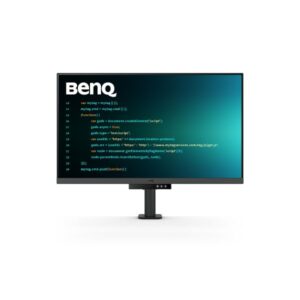
The BenQ RD280UA is built for one job: writing code.
Benq●Monitor
Display
28.2-inch, IPS, 3840 x 2560
28.2
Refresh Rate
60 Hz (hertz)
60 Hz
Brightness
350 cd/m² (peak 400 cd/m²)
350 cd
Contrast Ratio
1200 : 1
1200
Pros & Cons
Pros
- 3:2 at 3840 x 2560 substantially more code lines than 16:9
- 163 PPI with a Nano Matte anti-glare coating
- Coding Mode with a dedicated hotkey
- Ergonomic arm stand with 275 degree swivel and 130 mm height
- 90 W USB-C docking, EyeSafe 2.0 and TCO Certified 9.0
Cons
- 60 Hz with a 5 ms response not for gaming
- 3:2 letterboxes 16:9 video
- DisplayHDR 400 at 1200:1 is nominal
- No pivot despite the ergonomic arm
Score & Ratings
8/10
Great
Model Information
14
| Specification | Value |
|---|---|
| Brand | BenQ |
| Series | RD |
| Model | RD280UA |
| Full Product Name | BenQ RD280UA |
| Model Year | 2024 |
| Monitor Type | Business / Professional Monitor |
| Monitor Category | Programming / Coding Monitor |
| Market Position | Programming-Focused |
| Primary Use | Software Development & Programming |
| Region / Variant | Not specified |
| Launch Status | Model year 2024 |
| Available Colors | Black |
| Warranty | 3 years (36 months) |
| Burn-In Warranty | Not applicable (non-OLED panel) |
Display & Panel
13
| Specification | Value |
|---|---|
| Screen Size | 28.2-inch |
| Exact Diagonal | 716.495 mm / 71.6495 cm / 28.2085 in / 2.3507 ft |
| Screen Format | 3:2 |
| Aspect Ratio | 3:2 |
| Active Display Width | 596.16 mm / 59.616 cm / 23.4709 in / 1.9559 ft |
| Active Display Height | 397.44 mm / 39.744 cm / 15.6472 in / 1.3039 ft |
| Display Area | 90.74 % (percent) |
| Panel Type | IPS (BOE) |
| Panel Technology | Nano Matte Panel |
| Panel Manufacturer | BOE |
| Backlight Type | W-LED |
| 3D Support | No |
| Screen Coating | Anti-glare / Matte (3H) / Nano Matte Panel |
28.2" Display Size (71.6 cm) 16:10
Resolution & Pixel Details
3
| Specification | Value |
|---|---|
| Native Resolution | 3840 × 2560 |
| Pixel Density | 163 PPI |
| Pixel Pitch | 0.155 mm (millimeters) |
Resolution at a Glance
Picture Quality & Color
12
| Specification | Value |
|---|---|
| Panel Bit Depth | 10 bits (8 bits + FRC) (FRC: Yes) |
| FRC | Yes |
| Display Colors | 1073741824 colors |
| Typical Brightness | 350 cd/m² |
| Peak Brightness | 400 cd/m² |
| Static Contrast Ratio | 1200 : 1 |
| Horizontal Viewing Angle | 178 ° |
| Vertical Viewing Angle | 178 ° |
| HDR Support | HDR10 |
| HDR10 | Yes |
| sRGB Coverage | 100% |
| DCI-P3 Coverage | 95% |
DESK DISTANCE FIT
65cm
CompactIdeal FitWideUltra-Wide
Fills central vision comfortably at a typical desk distance — no head movement needed.
Refresh Rate, Response & Gaming
6
| Specification | Value |
|---|---|
| Native Refresh Rate | 60 Hz |
| Refresh Rate Range | 60 Hz (hertz) |
| Minimum Response Time | 5 ms / 0.0050 s |
| Motion Blur Reduction | Yes |
| Picture-by-Picture | Yes |
| Picture-in-Picture | Yes |
Ports & Connectivity
14
| Specification | Value |
|---|---|
| HDMI Ports | 1× HDMI 2.0 |
| HDMI Version | HDMI 2.0 |
| DisplayPort Input | 1× DisplayPort 1.4 |
| DisplayPort Version | DisplayPort 1.4 |
| USB-C Video Input | 1× USB-C |
| DisplayPort Alt Mode | Yes |
| USB-C Data Speed | 5 Gbps (USB 3.2 Gen 1) |
| USB-C Power Delivery | 90W |
| USB-A Ports | 3 |
| USB-B Upstream | 1× USB-B |
| KVM Switch | Yes |
| Daisy Chaining | Yes |
| Audio Output | 3.5 mm |
| Headphone Output | 3.5 mm Audio Out |
Ports & Connections
Audio, Camera, Network & Smart Features
2
| Specification | Value |
|---|---|
| Built-In Speakers | 2 x 2 W |
| Built-In Camera | No |
Ergonomics & Stand
17
| Specification | Value |
|---|---|
| VESA Mount | 100 x 100 mm |
| VESA Size | 100 × 100 mm |
| Removable Stand | Yes |
| Height Adjustment | 130 mm |
| Height Range | 130 mm |
| Height Adjustment Range | 130 mm / 13 cm / 5.1181 in / 0.4265 ft |
| Tilt Adjustment | Yes |
| Forward Tilt | 5 ° |
| Backward Tilt | 30 ° / Ergonomic Arm |
| Swivel Adjustment | Yes |
| Left Swivel | 275 ° |
| Right Swivel | 275 ° |
| Left Pivot | 0 ° |
| Right Pivot | 90 ° |
| Portrait Mode | Yes |
| Security Lock | Yes |
| Anti-Theft Lock | Kensington Lock |
Dimensions, Weight & Design
5
| Specification | Value |
|---|---|
| Dimensions With Stand | 610.4 mm x 732.2 mm x 476 mm (W x H x D) |
| Dimensions Without Stand | 610.4 mm x 427.8 mm x 87.1 mm (W x H x D) |
| Weight With Stand | 11.4 kg |
| Weight Without Stand | 7.5 kg |
| Stand Depth | 476 mm / 47.6 cm / 18.7402 in / 1.5617 ft |
Power & Operating Conditions
13
| Specification | Value |
|---|---|
| Power Input | 100–240V |
| 110V Input Range | 100 V - 120 V |
| 220V Input Range | 220 V - 240 V |
| AC Frequency | 50/60Hz |
| Typical Power Consumption | 34W |
| Average Power Consumption | 34W |
| Maximum Power Consumption | 205W |
| Operating Temperature | 5 °C - 35 °C / 41 °F - 95 °F |
| Operating Humidity | 10% – 80% |
| Operating Altitude | 5000 m / 16404.2 ft |
| Storage Temperature | -20 °C - 60 °C / -4 °F - 140 °F |
| Storage Humidity | 5 % - 85 % |
| Storage Altitude | 12192 m / 40000 ft |
Eye Care, Protection & Additional Features
12
| Specification | Value |
|---|---|
| Flicker-Free | Yes |
| Low Blue Light | Yes |
| Eye Comfort Mode | Yes |
| Reader Mode | Yes |
| Auto Brightness | Yes |
| Ambient Light Sensor | Yes |
| Proximity Sensor | Yes |
| Desktop Control Software | Yes |
| Monitor Management Software | Yes |
| Screen Split | Yes |
| Anti-Theft Slot | Yes (Kensington lock slot) |
| Additional Monitor Features | AMA (Advanced Motion Accelerator), Brightness Intelligence Gen 2 (B.I. Gen 2), Coding HotKey, Coding Mode, Color Weakness Mode, Daisy Chaining, Display Pilot 2 (Shortcuts / Desktop Partition / Application Mode / Software Dimming / Circadian Mode), DualView Plus, ePaper, Eye-Care, Eye Reminder, Flicker-free technology, KVM Switch, Low Blue Light Plus, MoonHalo, Night Hours Protection, Picture-by-Picture, Picture-in-Picture, Roximity Sensor / Light Sensor; Anti-theft stand lock slot - Kensington; Other certifications: EyeSafe Certified 2.0 |
Certifications, Standards & Licenses
7
| Specification | Value |
|---|---|
| Energy Star | Energy Star 8.0 |
| EPEAT | EPEAT Bronze |
| TCO Certified | TCO Certified 9.0 |
| TÜV Flicker-Free | TÜV Rheinland Flicker-free Certified |
| TÜV Low Blue Light | TÜV Rheinland Low Blue Light Certified (Hardware Solution) |
| TÜV Eye Comfort | Yes |
| VESA DisplayHDR | Display / HDR 400 |
Included Accessories
3
| Specification | Value |
|---|---|
| HDMI Cable | HDMI cable |
| USB-C Cable | USB Type-C cable |
| USB Upstream Cable | USB Type-B cable |
⚡
Estimated Running Cost
Based on this product's rated power draw, not an independent lab measurement — actual usage varies with settings and content.
Daily—
Monthly—
Annually—
Uses about 54% less power than the average we track in this category.
Reviews
DISPLAYINPUT · INDEPENDENT · SPEC-BASED · NO SPONSORED PLACEMENT
SHEET № RD280UA