
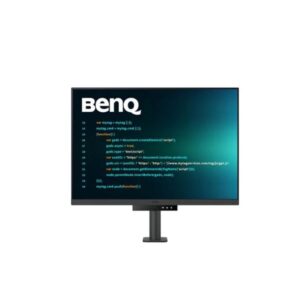
28.2″ BenQ RD280U – Specs & Features
Benq ● Monitor ●
At a glance
The 28.2″ BenQ RD280U – Specs & Features is a monitor from Benq featuring 2024 model year, 28.2-inch size class and IPS (BOE) panel type. Across our display performance benchmarks it scores Great — 7.6/10.
Model Year2024
Size Class28.2-inch
Panel TypeIPS (BOE)
📈Display Performance
Overall Score
Combined display quality score
76
/100
Refresh Rate
Higher is smoother — 144Hz+ ideal for gaming
25
/100
Response Time
Lower is better — 1ms excellent
40
/100
Color Coverage
% of DCI-P3 / sRGB gamut — higher = more vivid
100
/100
Brightness
Peak brightness in nits — 1000+ for HDR
35
/100
The Benq 28.2″ BenQ RD280U – Specs & Features achieves an overall display score of 7.6/10. With a 60Hz refresh rate and 5ms response time, it delivers smooth visuals for everyday use. Color coverage reaches 100% of DCI-P3, making it suitable for professional color work. Brightness of 350 nits is adequate for indoor use.
🎯
Who Should Buy the Benq RD280U
Perfect For
🎨
Photo Editors & Colour Graders 100% P3
Screen colours match print and web export
🌤️
Casual Viewers Wanting HDR HDR400
Entry-level HDR — better than SDR, not premium
💼
Home Office & Remote Workers Work
Reliable all-day viewing for desk work
Not Ideal For
🎮
Competitive Gamers 60Hz
60Hz cannot compete with 144Hz+ panels — fast motion blurs visibly in FPS games.
🎬
Premium HDR Viewers HDR400
Entry-level HDR400 cannot deliver the cinematic HDR experience. Seek HDR600+ or OLED for real impact.
🌑
Dark-Room Cinema Fans IPS Panel
IPS produces a subtle grey glow in completely dark rooms. VA or OLED produces genuinely black dark scenes.
💡
Quick Advice: Buy this for
professional colour work.
Ideal for creators and editors. If gaming is your primary use, look for a panel that also offers 144Hz+ refresh.
⚡
Real-World Use Cases
🖌️
What you grade is what the client receives
100% DCI-P3 keeps profiles consistent from Lightroom to print export.
📊
Colour accurate at every angle, all day
IPS stays consistent at 178° — shared-screen reviews and standing desks included.
🌅
Brightness range SDR cannot show
HDR content on Netflix and Game Pass gets expanded highlights and shadow depth. Note: HDR400 is entry-level — highlights improve over SDR but fall short of the full cinematic HDR experience.
Each scenario is derived from confirmed Benq RD280U specs. Real-world results vary with system configuration and content source.
⚖️Pros & Cons
Pros
- IPS Nano Matte panel wide viewing angles with professional-grade glare reduction for precise work
- HDR support (HDR10 / DisplayHDR 400) at 400 cd/m² peak wider dynamic range for lifelike content
- Full HD at 163 PPI clear, clean image for everyday computing and gaming
- 95% DCI-P3 near-complete wide-gamut coverage for professional design and photography work
- Full ergonomic stand (height, swivel, tilt) adaptable positioning for comfortable long work sessions
Cons
- IPS contrast (1200 : 1) blacks appear grey in dark environments compared to VA or OLED panels
- No portrait pivot stand cannot rotate vertically for document or code-reading layouts
- No Thunderbolt 4 USB-C available but limited to lower bandwidth without 40 Gbps capability
- DisplayHDR 400 is entry-tier modest HDR uplift without meaningful local dimming capability
- Peak power consumption (205W) above average; factor into long-term energy running costs
We evaluated the Benq RD280U across 10 criteria. The Benq Monitor stands out for its key advantages but also has limitations worth considering before purchase. Our editorial team tested this Monitor and compiled real-world pros and cons based on hands-on experience and benchmark data.
📊Score & Ratings
7.6/10
Great
The Benq RD280U earns a outstanding overall rating of 7.6/10. Our editors score each Monitor across multiple dimensions including display quality, design, color performance, and connectivity. This Monitor represents a top-tier choice in the Monitor market.
🔖
Basic Information
5
| Specification | Value | 💡 What It Means |
|---|---|---|
| Brand | BenQ | |
| Model | RD280U | |
| Series | RD | |
| Model Alias | - | |
| Model Year | 2024 |
✓ Good 2024 — recent model. Most modern features included.
|
🖥️
Display
8
| Specification | Value | 💡 What It Means |
|---|---|---|
| Size Class | 28.2-inch |
✓ Good 28" — popular desktop size. Enough space for multitasking without head movement.
|
| Panel Type | IPS (BOE) |
✓ Good IPS — consistent colour accuracy across 178° viewing angle. No colour shift when viewed from the side.
|
| Curvature | -- | |
| Resolution | 3840 x 2560 |
✓ Good 4K UHD (3840×2160) — four times 1080p. Pin-sharp text, exceptional photo and video detail at any screen size.
|
| Aspect Ratio | 3:2 | |
| Pixel Density | 163 PPI |
✓ Good 163 PPI — sharp. Individual pixels not visible at typical desk distance.
|
| Pixel Pitch | 0.155 mm (millimeters) |
✓ Good 0.155 mm (millimeters) pitch — fine. Comfortable sharpness at desk viewing distances.
|
| Display Area | 90.74 % (percent) |
🎨
Color & HDR
5
| Specification | Value | 💡 What It Means |
|---|---|---|
| Color Depth | 10 bits (8 bits + FRC) (FRC: Yes) |
✓ Good 10-bit — 1.07 billion colours. Eliminates colour banding in HDR skies, skin tones and gradients.
|
| Colors | 1073741824 colors |
✓ Good 1.07 billion colours (10-bit) — smooth HDR gradients; no visible banding in any content.
|
| sRGB | 100% |
✓ Good 100% sRGB — virtually complete coverage. Colour output matches what clients and printers receive exactly.
|
| DCI-P3 Coverage | 95% |
✓ Good 95% DCI-P3 — excellent for professional work. Reliable for photo editing and video colour grading.
|
| HDR Support | HDR10 DisplayHDR 400 |
△ Average HDR10 — universal HDR baseline. Supported by all streaming services, games, and HDR discs.
|
☀️
Brightness & Contrast
3
| Specification | Value | 💡 What It Means |
|---|---|---|
| Brightness (Typical) | 350 cd/m² |
△ Average 350 cd/m² — comfortable indoors. May wash out next to a bright window or in direct sunlight.
|
| Peak Brightness | 400 cd/m² |
△ Average 400 cd/m² — adequate for bright rooms and entry HDR. Standard office use is comfortable.
|
| Contrast | 1200 : 1 |
△ Average 1200 : 1 — standard IPS-level. Blacks appear slightly grey in very dark rooms.
|
⚡
Performance
3
| Specification | Value | 💡 What It Means |
|---|---|---|
| Refresh Rate | 60 Hz (hertz) |
⚠ Limited 60Hz — standard baseline. Fine for streaming and productivity; no motion clarity advantage in games.
|
| Response Time | 5 ms (GtG) |
△ Average 5 ms (GtG) GtG — acceptable for office and casual gaming. Some blur visible in very fast scenes.
|
| Adaptive Sync | - |
🖥️
Display Technologies
1
| Specification | Value | 💡 What It Means |
|---|---|---|
| Advanced Display Technologies | Panel Technology: Nano Matte Panel Backlight: W-LED Viewing Angles: 178° / 178° (H / V) MPRT Response: - Dynamic Contrast: - Input Lag: - Screen Coating: Anti-glare/Matte (3H) |
Anti-glare matte coating. 178° wide viewing angles.
|
📷
Camera
1
| Specification | Value | 💡 What It Means |
|---|---|---|
| Camera | No |
⚠ Limited No built-in camera. An external webcam is needed for video calls.
|
🔊
Audio
1
| Specification | Value | 💡 What It Means |
|---|---|---|
| Audio | 2 x 2 W (watts) | 3.5 mm Audio Out |
3.5mm headphone/audio output — connects wired headphones or routes audio to external speakers.
|
🔌
Connectivity & Ports
2
| Specification | Value | 💡 What It Means |
|---|---|---|
| Ports | 1 x USB 3.2 (Type-C; Gen 1; 5 Gbps; upstream; 90W; DP Alt Mode) 1 x USB 3.2 (Type-C; Gen 1; 5 Gbps; MST; data transfer; 7.5W) 1 x USB 3.2 (Type-B; Gen 1; 5 Gbps; upstream) 3 x USB 3.2 (Type-A; Gen 1; 5 Gbps; downstream; 4.5W) 1 x HDMI 2.0 1 x DisplayPort 1.4 1 x 3.5 mm Audio Out |
✓ Good USB-C (single-cable display + data, charging if PD supported). HDMI 2.0 — 4K@60Hz max bandwidth. DisplayPort 1.4 — full bandwidth for high-refresh PC gaming.
|
| Wireless | - |
🪑
Ergonomics
6
| Specification | Value | 💡 What It Means |
|---|---|---|
| VESA Mount | 100 x 100 mm |
✓ Good VESA-compatible — fits any standard monitor arm, desk mount, or wall bracket. No proprietary hardware needed.
|
| Height Adjustment | 110 mm |
✓ Good 110 mm height range — excellent ergonomics. Adapts to any chair height or desk setup.
|
| Pivot | No | |
| Swivel | ±15° |
✓ Good Swivel — rotates left and right without moving the base. Easy screen sharing or multi-person viewing.
|
| Tilt | -5° to +20° |
✓ Good Tilt ±5° — adjustable screen angle reduces neck strain and matches your eye level.
|
| Removable Stand | Yes |
✓ Good Stand detaches cleanly from the panel — mount on any VESA arm or wall bracket without a leftover collar.
|
🎮
Gaming Features
1
| Specification | Value | 💡 What It Means |
|---|---|---|
| Gaming Features | AMA (Advanced Motion Accelerator) |
📺
Smart & Software Features
2
| Specification | Value | 💡 What It Means |
|---|---|---|
| Operating System | - |
No smart OS — this is a PC monitor. All input comes from connected computers or consoles.
|
| Smart Features | Brightness Intelligence Gen 2 (B.I. Gen 2) Coding HotKey Coding Mode Color Weakness Mode Daisy Chaining DualView Plus ePaper Eye-Care Eye Reminder Flicker-free technology KVM Switch Low Blue Light Plus MoonHalo Night Hours Protection Picture-by-Picture Picture-in-Picture Roximity Sensor / Light Sensor |
✓ Good Brightness Intelligence Gen 2 (B.I. Gen 2)
Coding HotKey
Coding Mode
Color Weakness Mode
Daisy Chaining
DualView Plus
ePaper
Eye-Care
Eye Reminder
Flicker-free technology
KVM Switch
Low Blue Light Plus
MoonHalo
Night Hours Protection
Picture-by-Picture
Picture-in-Picture
Roximity Sensor / Light Sensor — smart TV platform with built-in streaming apps and voice control.
|
⚡
Power Consumption
5
| Specification | Value | 💡 What It Means |
|---|---|---|
| Voltage | 100–240V |
✓ Good Universal or wide-range power supply. Compatible with outlets in the US, UK, EU, and most countries.
|
| Frequency | 50/60Hz |
50/60Hz AC supply — compatible with worldwide power grids including US, UK, EU, and AU.
|
| Average Consumption | 34W |
✓ Good 34W — efficient for a display of this size and capability.
|
| Maximum Consumption | 205W | |
| Standby | - |
Standby power not listed. Modern displays typically draw under 0.5W in standby.
|
📋
Certificates
1
| Specification | Value | 💡 What It Means |
|---|---|---|
| Certificates | Energy Star 8.0 EPEAT Bronze EyeSafe Certified 2.0 Eye Comfort 2.0 TCO Certified 9.0 TÜV Rheinland Flicker-free Certified TÜV Rheinland Low Blue Light Certified (Hardware Solution) |
✓ Good ENERGY STAR — US energy efficiency standard. EPEAT — sustainable electronics certification. CE — meets EU safety & electromagnetic standards. TCO Certified — sustainable IT product standard. Eyesafe — certified blue-light reduction.
|
📐
Design, Build & Dimensions
9
| Specification | Value | 💡 What It Means |
|---|---|---|
| Without Stand Width | 610.4 mm |
Panel dimensions without stand attached. Use for wall-mount space planning.
|
| Without Stand Height | 427.8 mm |
Panel dimensions without stand attached. Use for wall-mount space planning.
|
| Without Stand Depth | 87.1 mm |
Panel dimensions without stand attached. Use for wall-mount space planning.
|
| Without Stand Weight | 7.5 kg |
△ Average 7.5 kg — standard weight for this panel size.
|
| With Stand Width | 610.4 mm |
Overall footprint with stand. Use when planning desk or shelf placement.
|
| With Stand Height | 474.3 mm |
Overall footprint with stand. Use when planning desk or shelf placement.
|
| With Stand Depth | 244.5 mm |
Overall footprint with stand. Use when planning desk or shelf placement.
|
| With Stand Weight | 10.4 kg |
△ Average 10.4 kg — standard weight for this panel size.
|
| Color | Black |
Available colour finish for this unit.
|
📋
Operating Conditions
2
| Specification | Value | 💡 What It Means |
|---|---|---|
| Temperature | 5°C – 35°C |
Operating environment range. Keep within these limits for reliable long-term performance.
|
| Humidity | 10% – 80% |
Operating environment range. Keep within these limits for reliable long-term performance.
|
❓
Frequently Asked Questions — Benq RD280U
01 What type of panel does the Benq RD280U use? ›
It features an IPS panel, which delivers wide 178° viewing angles and consistent colour accuracy. Colours stay accurate whether you're sitting centred or off to the side.
02 How smooth is the Benq RD280U for everyday use? ›
The 60Hz refresh rate makes scrolling, animations, and cursor movement visibly smoother than a 60Hz screen. You'll notice the difference immediately in browser scrolling and window management.
03 Is the HDR on the Benq RD280U any good? ›
The HDR400 certification is entry-level HDR ⚠ Not premium HDR. It unlocks HDR signals from Netflix and other platforms, providing a step up from SDR. However, peak brightness is not high enough for the full cinematic HDR effect — panels rated HDR600 or above deliver that. For casual HDR viewing it is fine; for dedicated HDR enthusiasts it is not.
04 Is the Benq RD280U suitable for photo or video editing? ›
✓ Yes — 100% DCI-P3 coverage means the colours you grade in Lightroom or DaVinci Resolve stay consistent when exported to screen and print. Suitable for professional colour work without a dedicated calibration monitor.
05 Who is the Benq RD280U best for? ›
It is best suited for content creators. It is less ideal for hardcore gaming or premium HDR experiences — there are better-spec'd options for those needs. Check the "Who Should Buy" section above for a full profile breakdown.
06 Does the IPS panel cause issues in dark rooms? ›
IPS panels produce a slight glow in very dark rooms when displaying black content — this is normal for the technology. It is most noticeable in pitch-black rooms. For dark-room cinematic use, a VA or OLED panel would produce deeper blacks. For everyday and office use it is not an issue.
07 Is the Benq RD280U worth buying in 2026? ›
It remains a competitive option for content creators. Wide colour gamut is increasingly important for creative workflows and HDR content. Check current pricing against alternatives to confirm value at the time of purchase.
Questions are generated from Benq RD280U specifications. For full technical data, see the Specifications tab above.
💬Reviews
Disclaimer: You can write your own disclaimer from APS Settings -> General -> Disclaimer Note.
Similar Monitors
27″ MSI MAG 274QRFW X32 – Specs & FeaturesPanel Type IPSResolution 2560 x 1440HDR Support DisplayHDR 400Brightness (Typical) 300 cd/m²
27″ Dell P2725DE – Specs & FeaturesPanel Type IPSResolution 2560 x 1440Brightness (Typical) 350 cd/m²Refresh Rate 48 Hz - 100 Hz
27″ Dell S2725QC – Specs & FeaturesPanel Type IPS (BOE)Resolution 3840 x 2160Brightness (Typical) 350 cd/m²Refresh Rate 48 Hz - 120 Hz
27″ Dell Alienware AW2724DM – Specs & FeaturesPanel Type IPS (LG Display)Resolution 2560 x 1440HDR Support HDR10
DisplayHDR 600Brightness (Typical) 400 cd/m²
26.5″ MSI Pro Max 271UPXW12G – Specs & FeaturesPanel Type QD-OLED (Samsung)Resolution 3840 x 2160HDR Support DisplayHDR 400 True Black
HDR10Brightness (Typical) 250 cd/m²
26.5″ MSI MAG 274QP QD-OLED X24 – Specs & FeaturesPanel Type QD-OLED (Samsung)Resolution 2560 x 1440HDR Support DisplayHDR 400 True BlackBrightness (Typical) 200 cd/m²
27″ MSI Pro MP275QPG – Specs & FeaturesPanel Type IPSResolution 2560 x 1440HDR Support HDRBrightness (Typical) 300 cd/m²
27″ Dell S2725DC – Specs & FeaturesPanel Type IPSResolution 2560 x 1440Brightness (Typical) 350 cd/m²Refresh Rate 48 Hz - 144 Hz
27″ Dell Alienware AW2724HF – Specs & FeaturesPanel Type IPSResolution 1920 x 1080HDR Support HDR10Brightness (Typical) 400 cd/m²
27″ MSI Pro MP273Q E7 – Specs & FeaturesPanel Type IPSResolution 2560 x 1440Brightness (Typical) 250 cd/m²Refresh Rate 48 Hz - 100 Hz
More Benq RD Series
31.5″ BenQ RD320UA – Specs & FeaturesPanel Type IPSResolution 3840 x 2160HDR Support HDR10
DisplayHDR 400Brightness (Typical) 400 cd/m²
28.2″ BenQ RD280UA – Specs & FeaturesPanel Type IPS (BOE)Resolution 3840 x 2560HDR Support HDR10
DisplayHDR 400Brightness (Typical) 350 cd/m²
31.5″ BenQ RD320U – Specs & FeaturesPanel Type IPSResolution 3840 x 2160HDR Support HDR10
DisplayHDR 400Brightness (Typical) 400 cd/m²
24.1″ BenQ RD240Q – Specs & FeaturesPanel Type IPSResolution 2560 x 1600HDR Support HDR10Brightness (Typical) 300 cd/m²