
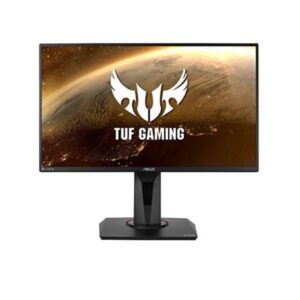
24.5″ Asus TUF Gaming VG259QMRL5A – Specs & Features
Built around an IPS panel, the ASUS TUF Gaming VG259QMRL5A runs at 1920 x 1080 pixels / Full HD / 1080p with a 48 Hz - 310 Hz refresh range.
Overview
Built around an IPS panel, the ASUS TUF Gaming VG259QMRL5A runs at 1920 x 1080 pixels / Full HD / 1080p with a 48 Hz - 310 Hz refresh range. On motion, the panel is rated 1 ms GtG and 0.3 ms (MPRT) MPRT; GtG and MPRT use different test methods, so treat them separately. For adaptive sync, it supports FreeSync, G-Sync, VESA AdaptiveSync Display 240Hz. Colour and light output come in at 400 cd/m² typical brightness, 1000 : 1 contrast and 99 % sRGB coverage. Ports include 2x HDMI 2.0, 1x DisplayPort 1.4.
Key Highlights
- IPS panel at 1920 x 1080 pixels / Full HD / 1080p
- 48 Hz - 310 Hz refresh range — built for competitive, fast-paced gaming
- 1 ms GtG / 0.3 ms (MPRT) MPRT response time
- 1000 : 1 contrast ratio
- 400 cd/m² typical brightness
- 99 % sRGB colour coverage
- FreeSync, G-Sync, VESA AdaptiveSync Display 240Hz
- Connectivity: 2x HDMI 2.0, 1x DisplayPort 1.4
Who Should Buy the Asus TUF Gaming VG259QMRL5A
Display Performance
Gaming Performance
HDR & Brightness Reality
DisplayHDR 400 is listed, but the sheet gives only a 400 cd/m² typical figure and no separate peak brightness. Without a published peak, there is no evidence of extra highlight output above normal operation. The 1,000:1 IPS contrast ratio also points to modest black depth, and no local dimming is stated. HDR10 acceptance may help compatibility, but the available hardware figures describe a fast SDR gaming monitor more convincingly than an HDR display.
Connectivity & Ports
Desk Fit & Ergonomics
Real-World Use Cases
Pros & Cons
- 48 Hz 310 Hz refresh range with 1 ms GtG response is built for competitive, fast-paced gaming
- FreeSync, G-Sync, VESA AdaptiveSync Display 240Hz give broad adaptive-sync compatibility
- 99 % sRGB coverage solid coverage for everyday colour accuracy
- Stand offers 120 mm (4.72 in) height adjustment, swivel, pivot
- Backed by 3 years
- 89 ppi / 35 ppcm is on the low side for sharp text at typical desk distance
- No USB-C or USB hub for peripheral connectivity
- No KVM switch for controlling two PCs from one keyboard/mouse
- IPS panels typically show lower native contrast than VA or OLED alternatives
- HDCP support isn’t explicitly confirmed for protected 4K/HDR streaming
Score & Ratings
| Specification | Value |
|---|---|
| Brand | ASUS |
| Series | TUF Gaming |
| Model | TUF Gaming VG259QMRL5A |
| Full Product Name | ASUS TUF Gaming VG259QMRL5A |
| Model Year | 2025 |
| Monitor Type | Gaming Monitor |
| Market Position | Value / Budget-Friendly Gaming |
| Primary Use | Competitive & Everyday Gaming on a Budget |
| Launch Status | 2025 |
| Available Colors | Black |
| Warranty | 3 years (36 months) standard limited warranty from date of purchase |
| Burn-In Warranty | Not applicable (non-OLED panel) |
| Specification | Value | What It Means |
|---|---|---|
| Screen Size | 24.5 in | |
| Exact Diagonal | 622.3 mm (24.50 in) | |
| Aspect Ratio | 16:9 | |
| Active Display Width | 543.744 mm (21.41 in) | |
| Active Display Height | 302.616 mm (11.91 in) | |
| Display Area | 89.47 % | |
| Panel Type | IPS | IPS affects viewing angles, black depth and color consistency — each panel technology trades these off differently. |
| Backlight Type | W-LED | |
| 3D Support | No | |
| Screen Coating | Anti-glare/Matte |
| Specification | Value | What It Means |
|---|---|---|
| Native Resolution | 1920 x 1080 pixels / Full HD / 1080p | |
| Pixel Density | 89 ppi / 35 ppcm | 89 ppi / 35 ppcm indicates how much scaling may be needed in the operating system for comfortable reading. |
| Pixel Pitch | 0.28 mm (0.01 in) |
| Specification | Value | What It Means |
|---|---|---|
| Panel Bit Depth | 8 bits | |
| FRC | No | |
| Display Colors | 16777216 colors / 24 bits | |
| Typical Brightness | 400 cd/m² | |
| Static Contrast Ratio | 1000 : 1 | |
| Horizontal Viewing Angle | 178 ° | |
| Vertical Viewing Angle | 178 ° | |
| HDR Support | DisplayHDR 400HDR10 |
|
| HDR10 | Yes | |
| sRGB Coverage | 99 % | 99 % indicates how much of that color space the panel can reproduce, which affects color accuracy for photo/video work. |
| Specification | Value |
|---|---|
| Native Refresh Rate | 310 Hz |
| Refresh Rate Range | 48 Hz - 310 Hz |
| Minimum Response Time | 1 ms |
| MPRT Response Time | 0.3 ms (MPRT) |
| Adaptive-Sync | Yes |
| AMD FreeSync | Yes |
| NVIDIA G-Sync | Yes |
| Motion Blur Reduction | Yes |
| Shadow Boost | Yes |
| Crosshair | Yes |
| Dynamic Crosshair | Yes |
| FPS Counter | Yes |
| AI Gaming Features | Yes |
| GameFast Input | Yes |
| GameVisual | Yes |
| Specification | Value |
|---|---|
| HDMI Ports | 2 |
| HDMI Version | 2.0 |
| HDMI Bandwidth | 31 kHz - 344 kHz |
| DisplayPort Input | 1 |
| DisplayPort Version | 1.4 |
| Audio Output | 3.5 mm |
| Headphone Output | 3.5 mm Audio Out |
| Specification | Value |
|---|---|
| Built-In Speakers | 2 x 2 W |
| Built-In Camera | No |
| Specification | Value | What It Means |
|---|---|---|
| VESA Mount | Yes | |
| VESA Size | 100 x 100 mm | |
| Removable Stand | Yes | |
| Height Adjustment | Yes | 120 mm (4.72 in) of travel allows the screen to be raised or lowered for a comfortable eye-level position. |
| Height Adjustment Range | 120 mm (4.72 in) | |
| Tilt Adjustment | Yes | |
| Forward Tilt | 5 ° | |
| Backward Tilt | 23 ° | |
| Swivel Adjustment | Yes | |
| Left Swivel | 15 ° | |
| Right Swivel | 15 ° | |
| Left Pivot | 90 ° | |
| Right Pivot | 90 ° | |
| Portrait Mode | Yes | |
| Security Lock | Yes | |
| Anti-Theft Lock | Kensington Lock |
| Specification | Value |
|---|---|
| Dimensions With Stand | 559 mm x 408 mm x 208 mm (W x H x D) |
| Dimensions Without Stand | 559 mm x 329 mm x 62 mm (W x H x D) |
| Weight With Stand | 4.9 kg (10.8 lbs) |
| Weight Without Stand | 2.9 kg (6.39 lbs) |
| Stand Depth | 208 mm (8.19 in) |
| Specification | Value |
|---|---|
| Power Input | 100–240V |
| 110V Input Range | 100 V - 120 V |
| 220V Input Range | 220 V - 240 V |
| AC Frequency | 50 Hz - 60 Hz |
| Average Power Consumption | 16 W |
| Sleep Consumption | 0.5 W |
| Off Consumption | 0.3 W |
| Operating Temperature | 0 °C - 40 °C / 32 °F - 104 °F |
| Operating Humidity | 10 % - 80 % |
| Specification | Value |
|---|---|
| Flicker-Free | Yes |
| Low Blue Light | Yes |
| Desktop Control Software | Yes |
| Monitor Management Software | Yes |
| Anti-Theft Slot | Yes (Kensington lock slot) |
| Additional Monitor Features | AI Visual; Asus DisplayWidget Center; Asus Power Sync; Color Temperature Selection (4 modes); Fast IPS; GameFast Input; GameVisual; Trace Free technology; TUF Gaming AI technology; Variable Overdrive |
| Specification | Value |
|---|---|
| Energy Star | Yes |
| TÜV Flicker-Free | Yes |
| TÜV Low Blue Light | Yes |
| VESA DisplayHDR | DisplayHDR 400 |
| VESA AdaptiveSync | Display 240Hz |
| Specification | Value |
|---|---|
| DisplayPort Cable | DisplayPort cable |
| Specification | Value |
|---|---|
| Package Dimensions | 628 mm x 515 mm x 143 mm (W x H x D) |
| Package Width | 628 mm (24.72 in) |
| Package Height | 515 mm (20.28 in) |
| Package Depth | 143 mm (5.63 in) |
| Package Weight | 6.6 kg (14.55 lbs) |