
MSI Pro Max 271UPXW12G vs MSI MAG 272QPW QD-OLED X24 Comparison
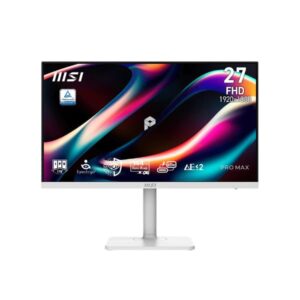
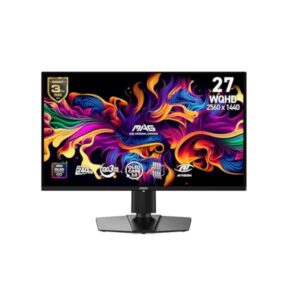
The MSI Pro Max 271UPXW12G is the better overall monitor for productivity and high-resolution work, while the MSI MAG 272QPW QD-OLED X24 is the better choice for high-refresh-rate gaming. Both use 26.5-inch QD-OLED panels, but the Pro Max delivers a much sharper 4K resolution, 165 PPI, 1000-nit peak brightness, 98W USB-C power delivery, KVM, and built-in speakers. The MAG 272QPW counters with a much faster 240Hz refresh rate, 3rd-generation QD-OLED technology, and dedicated gaming-oriented features. Choose the Pro Max 271UPXW12G for 4K productivity and connectivity. Choose the MAG 272QPW QD-OLED X24 for smoother competitive gaming.
The biggest difference is resolution. The MSI Pro Max 271UPXW12G uses a 3840×2160 4K panel with 165 PPI, while the MAG 272QPW uses 2560×1440 with 110 PPI. The Pro Max produces noticeably sharper text and finer detail, giving it a clear advantage for office work, photo editing, and other tasks where screen clarity matters.
The MAG 272QPW QD-OLED X24 is the faster gaming monitor, reaching 240Hz compared with 120Hz on the Pro Max. Both have an extremely fast 0.03ms response time and adaptive sync, but the MAG model is better suited to competitive gaming where high frame rates and smoother motion matter most. The Pro Max is better suited to mixed work and gaming.
Both monitors use QD-OLED technology with 1,500,000:1 contrast and 99% DCI-P3 coverage, but the Pro Max lists a much higher 1000-nit peak brightness compared with 400 nits on the MAG model. The Pro Max also supports HDR10 and offers additional color and uniformity controls, giving it a stronger specification sheet for HDR and display customization.
The Pro Max is considerably more capable as a workstation display. Its USB-C connection supports 98W power delivery, USB 3.2 data, four USB-A ports, USB-B upstream, and a KVM switch. The MAG 272QPW also accepts USB-C video but provides only 15W power delivery and lacks the same USB hub and KVM capabilities, making the Pro Max much more practical for laptop-based work.
| Specification | ||
|---|---|---|
| Overview | ||
| Rating | 8.6 / 10 | 8.4 / 10 |
| Brand | MSI | MSI |
| Category | Monitor | Monitor |
| Model Information | ||
| Brand | MSI | MSI |
| Series | Pro | MAG |
| Model | Pro Max 271UPXW12G | MAG 272QPW QD-OLED X24 |
| Full Product Name | MSI Pro Max 271UPXW12G | MSI MAG 272QPW QD-OLED X24 |
| Model Year | 2026 | 2025 |
| Monitor Type | Business / Professional Monitor | Gaming Monitor |
| Monitor Category | Productivity Monitor | -- |
| Market Position | Mainstream / Professional | Mainstream Gaming |
| Primary Use | Office, Productivity & Creative Work | Competitive & Immersive Gaming |
| Region / Variant | Global (regional SKU suffixes may vary, e.g. US/EU/APAC) | Global (regional SKU suffixes may vary, e.g. US/EU/APAC) |
| Launch Status | Announced 2026 (per manufacturer model-year data) | Available (2025 model-year, per manufacturer data) |
| Available Colors | White | Black |
| Warranty | 3 years standard limited warranty (MSI global policy; exact term/region may vary by country - see msi.com/page/warranty) | 3 years standard limited warranty (MSI global policy; exact term/region may vary by country - see msi.com/page/warranty) |
| Panel Warranty | 3 years | 3 years |
| Burn-In Warranty | 3 years OLED burn-in coverage (MSI's OLED panel guarantee, backed by MSI OLED Care) | 3 years OLED burn-in coverage (MSI's OLED panel guarantee, backed by MSI OLED Care) |
| Display & Panel | ||
| Screen Size | 26.5 in | 26.5 in |
| Exact Diagonal | 673.2 mm (26.50 in) | 673.1 mm (26.50 in) |
| Screen Format | 16:9 | -- |
| Aspect Ratio | 16:9 | 16:9 |
| Active Display Width | 589.97 mm (23.23 in) | 590.42 mm (23.24 in) |
| Active Display Height | 332.93 mm (13.11 in) | 333.72 mm (13.14 in) |
| Display Area | 87.37 % | 90.07 % |
| Panel Type? | QD-OLED | QD-OLED |
| Panel Technology | OLED | OLED |
| Panel Manufacturer | Samsung | Samsung |
| OLED Technology | QD-OLED | QD-OLED |
| OLED Generation | -- | 3rd Gen QD-OLED |
| Backlight Type? | Self-emissive (no backlight — OLED) | Self-emissive (no backlight — OLED) |
| Self-Emissive Display | Yes | Yes |
| Quantum Dot | Yes | Yes |
| 3D Support | No | No |
| Screen Coating | Anti-glare/Matte (3H) / Pure Black QD-OLED Penta Tandem / 4th Gen QD-OLED / EL Gen 3 technology / Dark Armor Film | Anti-glare/Matte (3H) |
| Resolution & Pixel Details | ||
| Native Resolution | 3840 x 2160 pixels / Ultra HD (UHD) / 4K / 2160p | 2560 x 1440 pixels / Quad HD (QHD) / 1440p |
| Pixel Density | 165 ppi / 65 ppcm | 110 ppi / 43 ppcm |
| Pixel Pitch | 0.153 mm (0.01 in) | 0.229 mm (0.01 in) |
| Subpixel Layout | V-Stripe (RGB Stripe) sub-pixel layout | -- |
| Picture Quality & Color | ||
| Panel Bit Depth | 10 bits | 10 bits |
| FRC | No | No |
| Display Colors | 1073741824 colors / 30 bits | 1073741824 colors / 30 bits |
| Typical Brightness | 250 cd/m² | 200 cd/m² |
| Peak Brightness | 1000 cd/m² | 400 cd/m² |
| Static Contrast Ratio | 1500000 : 1 | 1500000 : 1 |
| Horizontal Viewing Angle | 178 ° | 178 ° |
| Vertical Viewing Angle | 178 ° | 178 ° |
| HDR Support? | DisplayHDR 400 True Black /HDR10 |
DisplayHDR 400 True Black |
| HDR10? | Yes | -- |
| sRGB Coverage | 138.2 % | 138 % |
| DCI-P3 Coverage | 99 % | 99 % |
| Adobe RGB Coverage | 97.5 % | 98 % |
| Uniformity Compensation | Yes | -- |
| Gamma Adjustment | Yes | -- |
| Color Adjustment | Yes | -- |
| Refresh Rate, Response & Gaming | ||
| Native Refresh Rate | 120 Hz | 240 Hz |
| Refresh Rate Range | 48 Hz - 120 Hz | 48 Hz - 240 Hz |
| Minimum Response Time | 0.03 ms | 0.03 ms |
| Adaptive-Sync? | Yes | Yes |
| AMD FreeSync? | Yes | -- |
| Crosshair | Yes | Yes |
| AI Gaming Features | Yes | Yes |
| Console Mode | Yes | Yes |
| Picture-by-Picture | Yes | Yes |
| Picture-in-Picture | Yes | Yes |
| Ports & Connectivity | ||
| HDMI Ports | 2 | 2 |
| HDMI Version | 2.1 | 2.1 |
| HDMI Bandwidth | 30 k Hz - 270 k Hz | 30 k Hz - 390 k Hz |
| HDMI FRL | -- | Yes |
| HDMI CEC | -- | Yes |
| DisplayPort Input | 1 | 1 |
| DisplayPort Version | 1.4 | 1.4 |
| DisplayPort Bandwidth | -- | HBR3 |
| USB-C Video Input | Yes | Yes |
| DisplayPort Alt Mode | Yes | Yes |
| HDCP Support | Yes | -- |
| HDCP Version | 2.2 | -- |
| USB-C Data Speed | 5 Gbps (USB 3.2 Gen 1) | -- |
| USB-C Power Delivery | 98 W | 15 W |
| USB-A Ports | 4 | -- |
| USB-B Upstream | Yes | -- |
| KVM Switch | Yes | -- |
| Audio Output | 3.5 mm | 3.5 mm |
| Headphone Output | 3.5 mm Audio Out | 3.5 mm Audio Out |
| Audio, Camera, Network & Smart Features | ||
| Built-In Speakers | 2 x 2.5 W | -- |
| Built-In Camera | No | No |
| Ergonomics & Stand | ||
| VESA Mount | Yes | Yes |
| VESA Size | 100 x 100 mm | 100 x 100 mm |
| Removable Stand | Yes | Yes |
| Height Adjustment | Yes | Yes |
| Height Adjustment Range | 150 mm (5.91 in) | 110 mm (4.33 in) |
| Tilt Adjustment | Yes | Yes |
| Forward Tilt | 5 ° | 5 ° |
| Backward Tilt | 20 ° | 20 ° |
| Swivel Adjustment | Yes | Yes |
| Left Swivel | 30 ° | 30 ° |
| Right Swivel | 30 ° | 30 ° |
| Left Pivot | 90 ° | 90 ° |
| Right Pivot | 90 ° | 90 ° |
| Portrait Mode | Yes | Yes |
| Security Lock | Yes | Yes |
| Anti-Theft Lock | Kensington Lock | Kensington Lock |
| Dimensions, Weight & Design | ||
| Dimensions With Stand | 611.1 mm x 410.3 mm x 200.6 mm | 611.6 mm x 423 mm x 241.9 mm (W x H x D) |
| Dimensions Without Stand | 611.1 mm x 367.9 mm x 73 mm | 611.6 mm x 357.7 mm x 55.76 mm (W x H x D) |
| Weight With Stand | 7 kg (15.43 lbs) | 5.7 kg (12.57 lbs) |
| Stand Depth | 200.6 mm (7.90 in) | 241.9 mm (9.52 in) |
| Power & Operating Conditions | ||
| Power Input | 100–240V | 100–240V |
| 110V Input Range | 100 V - 120 V | 100 V - 120 V |
| 220V Input Range | 220 V - 240 V | 220 V - 240 V |
| AC Frequency | 50 Hz - 60 Hz | 50 Hz - 60 Hz |
| Sleep Consumption | 0.5 W | 0.5 W |
| Off Consumption | 0.3 W | 0.3 W |
| Operating Temperature | 0 °C - 40 °C / 32 °F - 104 °F | 0 °C - 40 °C / 32 °F - 104 °F |
| Operating Humidity | 20 % - 80 % | 10 % - 85 % |
| Operating Altitude | 3658 m / 12001.3 ft | 3657.6 m / 12000 ft |
| Storage Temperature | -20 °C - 60 °C / -4 °F - 140 °F | -25 °C - 55 °C / -13 °F - 131 °F |
| Storage Humidity | 10 % - 90 % | 5 % - 93 % |
| Storage Altitude | 12192 m / 40000 ft | 12192 m / 40000 ft |
| Eye Care, Protection & Additional Features | ||
| Flicker-Free | Yes | Yes |
| Low Blue Light | Yes | Yes |
| Eye Comfort Mode | Yes | -- |
| OLED Protection | Yes | Yes |
| OLED Care | Yes | Yes |
| Burn-In Protection | Yes (MSI OLED Care) | Yes (MSI OLED Care) |
| Thermal Management | -- | Yes |
| Custom Heatsink | -- | Yes |
| Graphene Cooling Film | -- | Yes |
| Desktop Control Software | Yes | Yes |
| Monitor Management Software | Yes | Yes |
| OSD Software | Yes | Yes |
| On-Screen Display | Yes | Yes |
| Screen Split | Yes | Yes |
| Uniformity Mode | Yes | -- |
| AI Visual | Yes | Yes |
| Anti-Theft Slot | Yes (Kensington lock slot) | Yes (Kensington lock slot) |
| Additional Monitor Features | 5-way Joystick Navigator; AI Care Sensor with an NPU-based chip; AI Menu; AI Vision; Aspect Ratio Control; Gaming Intelligence App; M-Color Mode for Mac Book sync; MSI Visi Clarity Technology; MSI Power Link; OLED Anti-Flicker Pro; Vis Clarity technology | 5-way Joystick Navigator; AI Vision; Aspect Ratio Options; Gaming Intelligence App; HDR Ready; Optix Scope; Other certifications: CCC; CEL |
| Certifications, Standards & Licenses | ||
| TÜV Flicker-Free | -- | Yes |
| TÜV Low Blue Light | -- | Yes |
| VESA DisplayHDR? | DisplayHDR 400 True Black | DisplayHDR 400 True Black |
| ClearMR | -- | 13000 |
| RoHS | -- | Yes |
| CE | -- | Yes |
| FCC | -- | Yes |
| UL | -- | Yes |
| Included Accessories | ||
| HDMI Cable | HDMI cable | -- |
| DisplayPort Cable | DisplayPort cable | DisplayPort 1.4 cable |
| USB Upstream Cable | USB Type-B to Type-A cable | -- |
| Packaging Information | ||
| Package Dimensions | -- | 820 mm x 513 mm x 169 mm (W x H x D) |
| Package Width | 810 mm (31.89 in) | 820 mm (32.28 in) |
| Package Height | 478 mm (18.82 in) | 513 mm (20.20 in) |
| Package Depth | 142 mm (5.59 in) | 169 mm (6.65 in) |
| Package Weight | 10.5 kg (23.15 lbs) | 9.4 kg (20.72 lbs) |
Methodology: The verdict and comparison notes on this page are written by an editor after reviewing the full specification table below; they are not generated by an automated scoring formula. Conclusions are based on manufacturer-listed specifications only - no benchmark testing, measured brightness or hands-on use is claimed unless stated. Missing values are left blank rather than estimated. Report an error.
Updated: August 2026
Frequently Asked Questions
The Pro Max 271UPXW12G is the stronger all-round choice for productivity because of its 4K resolution, higher pixel density, 98W USB-C power delivery, KVM, and built-in speakers.
Yes. Its 240Hz refresh rate is double that of the Pro Max 271UPXW12G, making it the better option for competitive gaming and high-frame-rate gameplay.
The MSI Pro Max 271UPXW12G is significantly sharper because its 3840×2160 resolution provides 165 PPI, compared with 110 PPI on the 2560×1440 MAG 272QPW.
Yes. Its USB-C port supports up to 98W power delivery along with data connectivity, four USB-A ports, USB-B upstream, and KVM functionality, while the MAG 272QPW provides only 15W power delivery.
The Pro Max 271UPXW12G has the stronger listed HDR specification, with 1000-nit peak brightness, HDR10 support, and additional display adjustment features. The MAG 272QPW reaches 400 nits and focuses more heavily on gaming performance.