
MSI MAG 272UP QD-OLED E16 vs ASUS ROG Swift OLED PG27UCWM Comparison
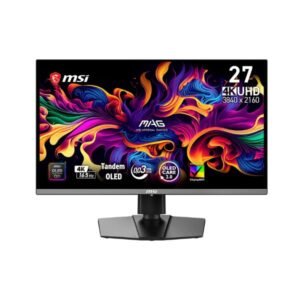
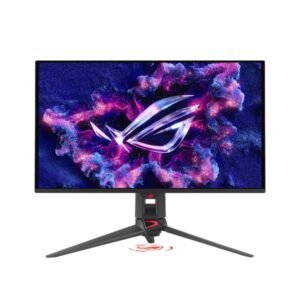
The ASUS ROG Swift OLED PG27UCWM is the better overall monitor, mainly because it combines the same 4K QD-OLED foundation with a faster 240Hz refresh rate, Dolby Vision, DisplayPort 2.1, and much stronger USB-C connectivity. Both monitors offer 26.5-inch 4K QD-OLED panels, 1000-nit peak brightness, 99% DCI-P3 coverage, and 0.03ms response time, so image quality is already excellent on both. The MSI MAG 272UP QD-OLED E16 remains attractive if you prefer its matte coating and OLED protection features. Choose the ASUS for maximum gaming performance and connectivity. Choose the MSI if you prefer a matte QD-OLED display and strong basic gaming features.
Both monitors use the same 26.5-inch 3840×2160 QD-OLED panel with 165 PPI, 1000-nit peak brightness, 1,500,000:1 contrast, and 99% DCI-P3 coverage. The main visual difference is the surface: the MSI uses a matte anti-glare coating, while the ASUS uses a glossy True Black finish. That gives the MSI a more controlled look in bright environments, while the ASUS is designed to emphasize OLED contrast and image clarity.
The ASUS has a clear speed advantage with a 240Hz refresh rate versus 165Hz on the MSI. Both achieve a 0.03ms response time and support G-Sync, but the ASUS is better suited to high-end competitive gaming when the GPU can drive high frame rates. The MSI still offers Adaptive-Sync, motion blur reduction, and console mode, making it a capable 4K gaming display for a wider range of systems.
The ASUS is significantly more advanced for modern PC setups. It includes DisplayPort 2.1 UHBR20, HDMI 2.1 with FRL, USB-C with 90W power delivery, three USB-A ports, and a KVM switch. The MSI also has HDMI 2.1 and USB-C video input, but its DisplayPort 1.4 connection and 15W USB-C power delivery make it much less capable as a single-cable laptop or workstation display.
Both support DisplayHDR 400 True Black and HDR10, but the ASUS adds Dolby Vision and a wider selection of display and gaming controls, including multiple HDR modes, Picture-in-Picture, Picture-by-Picture, GameVisual, and Shadow Boost. The MSI counters with OLED Care features such as pixel shift and static logo detection. The ASUS therefore offers more flexibility, while the MSI puts greater emphasis on OLED protection.
| Specification | ||
|---|---|---|
| Overview | ||
| Rating | 7.6 / 10 | 8.8 / 10 |
| Brand | MSI | Asus |
| Category | Monitor | Monitor |
| Model Information | ||
| Brand | MSI | ASUS |
| Series | -- | ROG Swift |
| Model | MAG 272UP QD-OLED E16 | ROG Swift OLED PG27UCWM |
| Model Alias | -- | ROG Swift OLED PG27UCWM |
| Full Product Name | MSI MAG 272UP QD-OLED E16 | ASUS ROG Swift OLED PG27UCWM |
| Model Year | 2026 | 2026 |
| Monitor Type | Gaming Monitor | Gaming Monitor |
| Monitor Category | Gaming Monitor | -- |
| Market Position | Mainstream Gaming | Premium / Flagship Gaming |
| Primary Use | Competitive & Immersive Gaming | Competitive Esports & High-End Immersive Gaming |
| Region / Variant | Global (regional SKU suffixes may vary, e.g. US/EU/APAC) | -- |
| Launch Status | Announced 2026 (per manufacturer model-year data) | -- |
| Available Colors | Black | Black |
| Warranty | 3 years standard limited warranty (MSI global policy; exact term/region may vary by country - see msi.com/page/warranty) | 3 years (36 months) standard limited warranty from date of purchase |
| Panel Warranty | 3 years | 3 years |
| Burn-In Warranty | 3 years OLED burn-in coverage (MSI's OLED panel guarantee, backed by MSI OLED Care) | 3 years (36 months) OLED panel burn-in coverage on most models |
| Display & Panel | ||
| Screen Size | 26.5 in | 26.5 in |
| Exact Diagonal | 673.1 mm (26.50 in) | 673.2 mm (26.50 in) |
| Screen Format | 16:9 | -- |
| Aspect Ratio | 16:9 | 16:9 |
| Active Display Width | 589.97 mm (23.23 in) | 589.97 mm (23.23 in) |
| Active Display Height | 332.93 mm (13.11 in) | 332.93 mm (13.11 in) |
| Display Area | 89.98 % | 87.84 % |
| Panel Type? | QD-OLED | QD-OLED |
| Panel Technology | OLED | OLED |
| Panel Manufacturer | Samsung | Samsung |
| OLED Technology | QD-OLED | QD-OLED |
| Backlight Type? | -- | Self-emissive |
| Self-Emissive Display | Yes | Yes |
| Quantum Dot | Yes | Yes |
| 3D Support | No | No |
| Screen Coating | Anti-glare/Matte (3H) / QD-OLED Penta Tandem / 4th Gen QD-OLED / Dark Armor Film | Glossy / True Black Glossy |
| Resolution & Pixel Details | ||
| Native Resolution | 3840 x 2160 pixels / Ultra HD (UHD) / 4K / 2160p | 3840 x 2160 pixels / Ultra HD (UHD) / 4K / 2160p |
| Pixel Density | 165 ppi / 65 ppcm | 165 ppi / 65 ppcm |
| Pixel Pitch | 0.153 mm (0.01 in) | 0.155 mm (0.01 in) |
| Picture Quality & Color | ||
| Panel Bit Depth | 10 bits | 10 bits |
| FRC | No | No |
| Display Colors | 1073741824 colors / 30 bits | 1073741824 colors / 30 bits |
| Typical Brightness | 250 cd/m² | 250 cd/m² |
| Peak Brightness | 1000 cd/m² | 1000 cd/m² |
| Static Contrast Ratio | 1500000 : 1 | 1500000 : 1 |
| Horizontal Viewing Angle | 178 ° | 178 ° |
| Vertical Viewing Angle | 178 ° | 178 ° |
| HDR Support? | DisplayHDR 400 True Black /HDR10 |
DisplayHDR 400 True Black /HDR10 /Dolby Vision |
| HDR10? | Yes | Yes |
| Dolby Vision | -- | Yes |
| sRGB Coverage | 138 % | 130 % |
| DCI-P3 Coverage | 99 % | 99 % |
| Adobe RGB Coverage | 98 % | -- |
| Uniformity Compensation | Yes | -- |
| Gamma Adjustment | -- | Yes |
| Refresh Rate, Response & Gaming | ||
| Native Refresh Rate | 165 Hz | 240 Hz |
| Refresh Rate Range | 48 Hz - 165 Hz | 48 Hz - 240 Hz |
| Minimum Response Time | 0.03 ms | 0.03 ms |
| Adaptive-Sync? | Yes | -- |
| AMD FreeSync? | -- | Yes |
| NVIDIA G-Sync? | Yes | Yes |
| Motion Blur Reduction | Yes | Yes |
| Shadow Boost | -- | Yes |
| Crosshair | Yes | Yes |
| Dynamic Crosshair | -- | Yes |
| AI Gaming Features | Yes | Yes |
| Console Mode | Yes | -- |
| GameFast Input | -- | Yes |
| GameVisual | -- | Yes |
| Picture-by-Picture | -- | Yes |
| Picture-in-Picture | -- | Yes |
| Ports & Connectivity | ||
| HDMI Ports | 2 | 2 |
| HDMI Version | 2.1 | 2.1 |
| HDMI Bandwidth | 30 k Hz - 368.8 k Hz | 106 k Hz - 583 k Hz |
| HDMI FRL | -- | Yes |
| HDMI CEC | Yes | -- |
| DisplayPort Input | 1 | 1 |
| DisplayPort Version | 1.4 | 2.1 |
| DisplayPort Bandwidth | HBR3 | UHBR20 |
| USB-C Video Input | Yes | Yes |
| DisplayPort Alt Mode | Yes | Yes |
| HDCP Support | Yes | Yes |
| HDCP Version | -- | 2.2 |
| USB-C Data Speed | -- | 5 Gbps (USB 3.2 Gen 1) |
| USB-C Power Delivery | 15 W | 90 W |
| USB-A Ports | -- | 3 |
| KVM Switch | -- | Yes |
| Audio Output | 3.5 mm | 3.5 mm |
| Headphone Output | 3.5 mm Audio Out | 3.5 mm Audio Out |
| Audio, Camera, Network & Smart Features | ||
| Built-In Camera | No | No |
| Ergonomics & Stand | ||
| VESA Mount | Yes | Yes |
| VESA Size | 100 x 100 mm | 100 x 100 mm |
| Removable Stand | Yes | Yes |
| Height Adjustment | Yes | Yes |
| Height Adjustment Range | 110 mm (4.33 in) | 110 mm (4.33 in) |
| Tilt Adjustment | Yes | Yes |
| Forward Tilt | 5 ° | 5 ° |
| Backward Tilt | 20 ° | 20 ° / 1/4" Tripod Socket |
| Swivel Adjustment | Yes | Yes |
| Left Swivel | 30 ° | 30 ° |
| Right Swivel | 30 ° | 30 ° |
| Left Pivot | -- | 90 ° |
| Right Pivot | -- | 90 ° |
| Portrait Mode | No | Yes |
| Security Lock | Yes | Yes |
| Anti-Theft Lock | Kensington Lock | Kensington Lock |
| Dimensions, Weight & Design | ||
| Dimensions With Stand | 611.1 mm x 422.8 mm x 241.9 mm | 606 mm x 438 mm x 256 mm (W x H x D) |
| Dimensions Without Stand | 611.1 mm x 357.2 mm x 69.3 mm | 606 mm x 369 mm x 63 mm (W x H x D) |
| Weight With Stand | 7.7 kg (16.98 lbs) | 8.1 kg (17.86 lbs) |
| Weight Without Stand | -- | 5.4 kg (11.9 lbs) |
| Stand Depth | 241.9 mm (9.52 in) | 256 mm (10.08 in) |
| RGB Lighting | -- | Yes |
| Power & Operating Conditions | ||
| Power Input | -- | 100 V - 120 V / 220 V - 240 V |
| 110V Input Range | 100 V - 120 V | 100 V - 120 V |
| 220V Input Range | 220 V - 240 V | 220 V - 240 V |
| AC Frequency | 50 Hz - 60 Hz | 50 Hz - 60 Hz |
| Average Power Consumption | -- | 50 W |
| Sleep Consumption | 0.5 W | 0.5 W |
| Off Consumption | 0.3 W | 0.3 W |
| Operating Temperature | 0 °C - 40 °C / 32 °F - 104 °F | 0 °C - 40 °C / 32 °F - 104 °F |
| Operating Humidity | 10 % - 90 % | 20 % - 80 % |
| Operating Altitude | 5000 m / 16404.2 ft | 3658 m / 12001.3 ft |
| Storage Temperature | -20 °C - 60 °C / -4 °F - 140 °F | -20 °C - 60 °C / -4 °F - 140 °F |
| Storage Humidity | 10 % - 80 % | 10 % - 90 % |
| Storage Altitude | 12192 m / 40000 ft | 12192 m / 40000 ft |
| Eye Care, Protection & Additional Features | ||
| Flicker-Free | Yes | Yes |
| Low Blue Light | Yes | Yes |
| Proximity Sensor | -- | Yes |
| OLED Protection | Yes | Yes |
| OLED Care | Yes | Yes |
| Pixel Shift | Yes | -- |
| Static Logo Detection | Yes | -- |
| Burn-In Protection | Yes (MSI OLED Care) | Yes (ASUS OLED Care / OLED Care Pro) |
| Thermal Management | Yes | Yes |
| Custom Heatsink | Yes | Yes |
| Desktop Control Software | -- | Yes |
| Monitor Management Software | -- | Yes |
| Screen Split | -- | Yes |
| Uniformity Mode | Yes | -- |
| AI Visual | Yes | -- |
| Aura Sync | -- | Yes |
| Multiple HDR Modes? | -- | Yes |
| Anti-Theft Slot | Yes (Kensington lock slot) | Yes (Kensington lock slot) |
| Additional Monitor Features | 3-sided frameless design; AI Vision; Aspect Ratio Options; Custom Heatsink; Game Assitance; Optix ScopeWide Color Gamut |
AI Visual; AsusDisplay Widget Center; Aura Sync; Clear Pixel Edge; Color Calibration E-report; Custom Heatsink; Game Fast Input; Game Visual; Ga NFET technology; Multiple HDR Mode; Neo Proximity Sensor; Uniform Brightness |
| Certifications, Standards & Licenses | ||
| TÜV Flicker-Free | -- | Yes |
| TÜV Low Blue Light | Yes | Yes |
| VESA DisplayHDR? | DisplayHDR 400 True Black | DisplayHDR 400 True Black |
| VESA AdaptiveSync? | -- | Display 240Hz |
| ClearMR | 9000 | -- |
| RoHS | Yes | -- |
| FCC | Yes | -- |
| FCC-B | Yes | -- |
| WEEE | Yes | -- |
| Included Accessories | ||
| HDMI Cable | -- | HDMI 2.1 cable |
| DisplayPort Cable | DisplayPort cable | DisplayPort 2.1 (DP80) cable |
| USB-C Cable | -- | USB Type-C cable |
| USB Upstream Cable | -- | USB 3.2 cable |
| Packaging Information | ||
| Package Dimensions | -- | 860 mm x 490 mm x 163 mm (W x H x D) |
| Package Width | -- | 860 mm (33.86 in) |
| Package Height | -- | 490 mm (19.29 in) |
| Package Depth | -- | 163 mm (6.42 in) |
| Package Weight | 10.9 kg (24.03 lbs) | 11.8 kg (26.01 lbs) |
Methodology: The verdict and comparison notes on this page are written by an editor after reviewing the full specification table below; they are not generated by an automated scoring formula. Conclusions are based on manufacturer-listed specifications only - no benchmark testing, measured brightness or hands-on use is claimed unless stated. Missing values are left blank rather than estimated. Report an error.
Updated: August 2026
Frequently Asked Questions
The ASUS ROG Swift OLED PG27UCWM is the stronger 4K gaming monitor because its 240Hz refresh rate is substantially higher than the MSI's 165Hz, while both retain a 0.03ms response time and QD-OLED contrast.
Core image specifications are very similar, with both using 4K QD-OLED panels, 1000-nit peak brightness, and 99% DCI-P3 coverage. The main difference is the MSI's matte finish versus the ASUS glossy display.
The ASUS PG27UCWM is clearly ahead with DisplayPort 2.1 UHBR20, 90W USB-C power delivery, three USB-A ports, and a KVM switch. The MSI provides fewer connectivity features and only 15W USB-C power delivery.
Yes. Both support DisplayHDR 400 True Black and HDR10, but the ASUS also supports Dolby Vision and offers multiple HDR modes, giving it more flexibility with HDR content.
Choose the ASUS if 240Hz gaming, advanced connectivity, and Dolby Vision matter to you. The MSI is worth considering when a matte QD-OLED surface and its OLED protection features are more important.