
MSI Pro Max 271PHW E14 vs ASUS TUF Gaming VG249QM5F Comparison
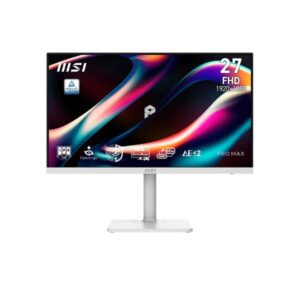
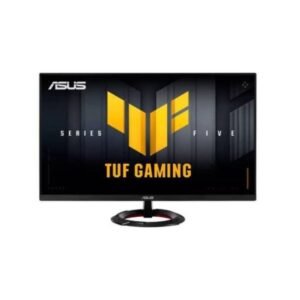
The ASUS TUF Gaming VG249QM5F is the better gaming monitor, while the MSI Pro Max 271PHW E14 is the more versatile choice for productivity and a comfortable desk setup. Both use 23.8-inch Full HD IPS panels, but ASUS delivers a much faster 260Hz refresh rate, 1ms response time, HDR10, FreeSync and G-Sync support, making it better suited to fast-paced gaming. MSI counters with USB-C connectivity, 65W power delivery, KVM, built-in speakers, and a fully adjustable stand. Choose the ASUS TUF Gaming VG249QM5F for competitive gaming. Choose the MSI Pro Max 271PHW E14 for work, multitasking, and USB-C productivity.
The ASUS TUF Gaming VG249QM5F has a clear advantage for fast-paced gaming with its 260Hz refresh rate, 1ms response time, 0.3ms MPRT mode, AMD FreeSync, NVIDIA G-Sync, and motion blur reduction. The MSI Pro Max 271PHW E14 reaches 144Hz and supports adaptive sync, but it is better suited to general gaming than competitive play where higher refresh rates matter.
The MSI Pro Max 271PHW E14 is much better equipped for productivity. Its USB-C connection supports DisplayPort Alt Mode, 5Gbps data transfer, and up to 65W power delivery, while two USB-A ports and a KVM switch make it useful for a laptop and desktop setup. The ASUS lacks USB-C video and power delivery, making it less flexible as a work hub.
MSI offers a significantly more adjustable stand, with 130mm of height adjustment plus swivel, pivot, and tilt support. The ASUS stand only provides tilt adjustment. For long work sessions, portrait documents, or a multi-monitor setup, the MSI gives you much more control over screen positioning. Both support VESA mounting, although MSI uses a 75×75mm mount and ASUS uses 100×100mm.
Both monitors use 23.8-inch Full HD IPS panels with 92 PPI, but the ASUS is brighter at 300 nits and adds HDR10 support. MSI offers wider sRGB coverage at 111%, while both have similar DCI-P3 coverage. ASUS also includes gaming-focused tools such as Shadow Boost, GameVisual, Dynamic Crosshair, FPS Counter, and Variable Overdrive, giving it a more gaming-oriented feature set.
| Specification | ||
|---|---|---|
| Overview | ||
| Rating | 6.8 / 10 | 7.0 / 10 |
| Brand | MSI | Asus |
| Category | Monitor | Monitor |
| Model Information | ||
| Brand | MSI | ASUS |
| Series | Pro | TUF Gaming |
| Model | Pro Max 271PHW E14 | TUF Gaming VG249QM5F |
| Full Product Name | MSI Pro Max 271PHW E14 | ASUS TUF Gaming VG249QM5F |
| Model Year | 2026 | 2026 |
| Monitor Type | Business / Professional Monitor | Gaming Monitor |
| Monitor Category | Productivity Monitor | -- |
| Market Position | Mainstream / Professional | Value / Budget-Friendly Gaming |
| Primary Use | Office, Productivity & Creative Work | Competitive & Everyday Gaming on a Budget |
| Region / Variant | Global (regional SKU suffixes may vary, e.g. US/EU/APAC) | -- |
| Launch Status | Announced 2026 (per manufacturer model-year data) | -- |
| Available Colors | White | Black |
| Warranty | 3 years standard limited warranty (MSI global policy; exact term/region may vary by country - see msi.com/page/warranty) | 3 years (36 months) standard limited warranty from date of purchase |
| Burn-In Warranty | Not applicable (non-OLED panel) | Not applicable (non-OLED panel) |
| Display & Panel | ||
| Screen Size | 23.8 in | 23.8 in |
| Exact Diagonal | 604 mm (23.78 in) | 604.7 mm (23.81 in) |
| Screen Format | 16:9 | -- |
| Aspect Ratio | 16:9 | 16:9 |
| Active Display Width | 527.04 mm (20.75 in) | 527.04 mm (20.75 in) |
| Active Display Height | 296.46 mm (11.67 in) | 296.46 mm (11.67 in) |
| Display Area | 70.27 % | 89.41 % |
| Panel Type? | IPS | IPS |
| Panel Technology | IPS | -- |
| Backlight Type? | W-LED | W-LED |
| 3D Support | No | No |
| Screen Coating | Anti-glare/Matte / Response time - 1 ms (MPRT - Motion Picture Response Time) | Anti-glare/Matte |
| Resolution & Pixel Details | ||
| Native Resolution | 1920 x 1080 pixels / Full HD / 1080p | 1920 x 1080 pixels / Full HD / 1080p |
| Pixel Density | 92 ppi / 36 ppcm | 92 ppi / 36 ppcm |
| Pixel Pitch | 0.275 mm (0.01 in) | 0.275 mm (0.01 in) |
| Picture Quality & Color | ||
| Panel Bit Depth | 8 bits (6 bits + FRC) | 8 bits |
| FRC | Yes | -- |
| Display Colors | 16777216 colors / 24 bits | 16777216 colors / 24 bits |
| Typical Brightness | 250 cd/m² | 300 cd/m² |
| Static Contrast Ratio | 1000 : 1 | 1000 : 1 |
| Horizontal Viewing Angle | 178 ° | 178 ° |
| Vertical Viewing Angle | 178 ° | 178 ° |
| HDR Support? | -- | HDR10 |
| HDR10? | -- | Yes |
| sRGB Coverage | 111 % | 99 % |
| DCI-P3 Coverage | 86 % | 88 % |
| Adobe RGB Coverage | 86 % | -- |
| Refresh Rate, Response & Gaming | ||
| Native Refresh Rate | 144 Hz | 260 Hz |
| Refresh Rate Range | 48 Hz - 144 Hz | 48 Hz - 260 Hz |
| Minimum Response Time | 4 ms | 1 ms |
| MPRT Response Time | -- | 0.3 ms (MPRT) |
| Adaptive-Sync? | Yes | Yes |
| AMD FreeSync? | -- | Yes |
| NVIDIA G-Sync? | -- | Yes |
| Motion Blur Reduction | -- | Yes |
| Shadow Boost | -- | Yes |
| Crosshair | -- | Yes |
| Dynamic Crosshair | -- | Yes |
| FPS Counter | -- | Yes |
| AI Gaming Features | -- | Yes |
| GameFast Input | -- | Yes |
| GameVisual | -- | Yes |
| Ports & Connectivity | ||
| HDMI Ports | 1 | 2 |
| HDMI Version | 2.0 | 2.1 |
| HDMI Bandwidth | 52.85 k Hz - 158.54 k Hz | 30 k Hz - 267 k Hz |
| DisplayPort Input | 1 | 1 |
| DisplayPort Version | 1.2 | 1.4 |
| USB-C Video Input | Yes | -- |
| DisplayPort Alt Mode | Yes | -- |
| HDCP Support | -- | Yes |
| USB-C Data Speed | 5 Gbps (USB 3.2 Gen 1) | -- |
| USB-C Power Delivery | 65 W | -- |
| USB-A Ports | 2 | -- |
| USB-B Upstream | Yes | -- |
| KVM Switch | Yes | -- |
| Audio Output | 3.5 mm | 3.5 mm |
| Headphone Output | 3.5 mm Audio Out | 3.5 mm Audio Out |
| Audio, Camera, Network & Smart Features | ||
| Built-In Speakers | 2 x 3 W | 2 x 2 W |
| Built-In Camera | No | No |
| Ergonomics & Stand | ||
| VESA Mount | Yes | Yes |
| VESA Size | 75 x 75 mm | 100 x 100 mm |
| Removable Stand | Yes | Yes |
| Height Adjustment | Yes | No |
| Height Adjustment Range | 130 mm (5.12 in) | -- |
| Tilt Adjustment | Yes | Yes |
| Forward Tilt | 5 ° | 5 ° |
| Backward Tilt | 20 ° | 20 ° |
| Swivel Adjustment | Yes | No |
| Left Swivel | 30 ° | -- |
| Right Swivel | 30 ° | -- |
| Left Pivot | 90 ° | -- |
| Right Pivot | 90 ° | -- |
| Portrait Mode | Yes | No |
| Security Lock | Yes | Yes |
| Anti-Theft Lock | Kensington Lock | Kensington Lock |
| Dimensions, Weight & Design | ||
| Dimensions With Stand | 613.49 mm x 401.37 mm x 200.81 mm | 541 mm x 394 mm x 174 mm (W x H x D) |
| Dimensions Without Stand | 613.49 mm x 362.45 mm x 63.81 mm | 541 mm x 323 mm x 58 mm (W x H x D) |
| Weight With Stand | 6.4 kg (14.11 lbs) | 3.4 kg (7.5 lbs) |
| Weight Without Stand | -- | 2.9 kg (6.39 lbs) |
| Stand Depth | 200.81 mm (7.91 in) | 174 mm (6.85 in) |
| Power & Operating Conditions | ||
| Power Input | 100–240V | -- |
| 110V Input Range | 100 V - 120 V | 100 V - 120 V |
| 220V Input Range | 220 V - 240 V | 220 V - 240 V |
| AC Frequency | 50 Hz - 60 Hz | 50 Hz - 60 Hz |
| Average Power Consumption | 18 W | 15 W |
| Sleep Consumption | 0.5 W | 0.5 W |
| Off Consumption | 0.5 W | 0.3 W |
| Operating Temperature | 0 °C - 40 °C / 32 °F - 104 °F | 0 °C - 40 °C / 32 °F - 104 °F |
| Operating Humidity | 10 % - 85 % | -- |
| Operating Altitude | 5000 m / 16404.2 ft | -- |
| Storage Temperature | -20 °C - 600 °C / -4 °F - 1112 °F | -20 °C - 60 °C / -4 °F - 140 °F |
| Storage Humidity | 10 % - 90 % | -- |
| Storage Altitude | 12192 m / 40000 ft | -- |
| Eye Care, Protection & Additional Features | ||
| Flicker-Free | Yes | Yes |
| Low Blue Light | Yes | Yes |
| Eye Comfort Mode | Yes | -- |
| Desktop Control Software | Yes | Yes |
| Monitor Management Software | Yes | Yes |
| Anti-Theft Slot | Yes (Kensington lock slot) | Yes (Kensington lock slot) |
| Additional Monitor Features | Eye-Q Check; MSI Eyes Ergo+; MSI M-Mate App; MSI Power Link; Overdrive; Spira Lume (Circular Polarizer) | AI Visual; AsusDisplay Widget Center; Asus Power Sync; Color Temperature Selection (4 modes); Fast IPS; Game Fast Input; Game VisualTrace Free Technology; Variable Overdrive |
| Certifications, Standards & Licenses | ||
| Energy Star | Yes | -- |
| TÜV Flicker-Free | Yes | Yes |
| TÜV Low Blue Light | Yes | Yes |
| CE | Yes | -- |
| FCC | Yes | -- |
| FCC-B | Yes | -- |
| WEEE | Yes | -- |
| Included Accessories | ||
| HDMI Cable | HDMI cable | -- |
| DisplayPort Cable | -- | DisplayPort cable |
| USB-C Cable | USB Type-C cable | -- |
| USB Upstream Cable | USB Type-B to Type-A cable | -- |
| Packaging Information | ||
| Package Dimensions | -- | 600 mm x 405 mm x 168 mm (W x H x D) |
| Package Width | -- | 600 mm (23.62 in) |
| Package Height | -- | 405 mm (15.94 in) |
| Package Depth | -- | 168 mm (6.61 in) |
| Package Weight | 10 kg (22.05 lbs) | 5 kg (11.02 lbs) |
Methodology: The verdict and comparison notes on this page are written by an editor after reviewing the full specification table below; they are not generated by an automated scoring formula. Conclusions are based on manufacturer-listed specifications only - no benchmark testing, measured brightness or hands-on use is claimed unless stated. Missing values are left blank rather than estimated. Report an error.
Updated: August 2026
Frequently Asked Questions
Yes. Its 260Hz refresh rate, 1ms response time, FreeSync, G-Sync, and motion blur reduction make it the stronger choice for high-refresh competitive gaming.
The MSI is better for productivity because it adds USB-C with 65W power delivery, KVM, USB-A ports, and a much more adjustable stand.
The MSI Pro Max 271PHW E14 has the more flexible stand, with height, swivel, pivot, and tilt adjustments. The ASUS model only supports tilt.
Yes. The ASUS supports HDR10, while the MSI Pro Max 271PHW E14 does not list HDR support in the supplied specifications.
The MSI Pro Max 271PHW E14 is the better choice because its USB-C port supports video, data transfer, and up to 65W power delivery, allowing a compatible laptop to connect through a single cable.
It can be, especially in competitive games when the system can maintain very high frame rates. For office work and casual gaming, the difference is less important than the MSI's productivity and ergonomic advantages.