
RATED
Excellent
9.4/10
26.5″ Asus PA27USD – Full Specifications
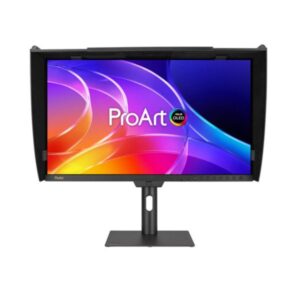
The ASUS PA27USD is a 3840 x 2160 pixels / Ultra HD (UHD) / 4K / 2160p QD-OLED monitor rated for a 48 Hz - 240 Hz refresh range.
Asus●Monitor
Display
26.5 in, QD-OLED, 3840 x 2160 pixels / Ultra HD (UHD) / 4K / 2160p
26.5
Refresh Rate
48 Hz - 240 Hz
48 Hz
Brightness
250 cd/m²
250 cd
Contrast Ratio
1500000 : 1
1500000
Pros & Cons
Pros
- 48 Hz 240 Hz refresh range with 0.1 ms GtG response is built for competitive, fast-paced gaming
- 1500000 : 1 contrast delivers near-infinite black depth
- VESA AdaptiveSync Display 240Hz give broad adaptive-sync compatibility
- 100 % sRGB coverage solid coverage for everyday colour accuracy
- Built-in USB hub adds convenient peripheral connectivity
Cons
- OLED burn-in care applies to static editing layouts
- 250 cd/m2 full-screen brightness needs controlled lighting
- 26.5 inches is small for multi-panel editing layouts
- 2 x 2 W speakers are a convenience, nothing more
Score & Ratings
9.4/10
Great
Model Information
13
| Specification | Value |
|---|---|
| Brand | ASUS |
| Series | ProArt |
| Model | PA27USD |
| Model Alias | ProArt Display OLED PA27USD |
| Full Product Name | ASUS ProArt PA27USD |
| Model Year | 2026 |
| Monitor Type | Professional / Creator Monitor |
| Market Position | Professional / Creator |
| Primary Use | Content Creation, Design & Color-Critical Work |
| Available Colors | Black |
| Warranty | 3 years (36 months) standard limited warranty from date of purchase |
| Panel Warranty | 3 years |
| Burn-In Warranty | 3 years (36 months) OLED panel burn-in coverage on most models |
Display & Panel
14
| Specification | Value |
|---|---|
| Screen Size | 26.5 in |
| Exact Diagonal | 673.2 mm (26.50 in) |
| Aspect Ratio | 16:9 |
| Active Display Width | 589.97 mm (23.23 in) |
| Active Display Height | 332.93 mm (13.11 in) |
| Display Area | 84.96 % |
| Panel Type | QD-OLED |
| Panel Technology | OLED |
| Panel Manufacturer | Samsung |
| OLED Technology | QD-OLED |
| Self-Emissive Display | Yes |
| Quantum Dot | Yes |
| 3D Support | No |
| Screen Coating | Glossy OLED |
26.5" Display Size (67.3 cm) 16:9
Resolution & Pixel Details
3
| Specification | Value |
|---|---|
| Native Resolution | 3840 x 2160 pixels / Ultra HD (UHD) / 4K / 2160p |
| Pixel Density | 165 ppi / 65 ppcm |
| Pixel Pitch | 0.155 mm (0.01 in) |
Resolution at a Glance
Picture Quality & Color
18
| Specification | Value |
|---|---|
| Panel Bit Depth | 10 bits |
| FRC | No |
| Display Colors | 1073741824 colors / 30 bits |
| Typical Brightness | 250 cd/m² |
| Peak Brightness | 1000 cd/m² |
| Static Contrast Ratio | 1500000 : 1 |
| Horizontal Viewing Angle | 178 ° |
| Vertical Viewing Angle | 178 ° |
| HDR Support | Dolby VisionHDR10HLG |
| HDR10 | Yes |
| HLG | Yes |
| Dolby Vision | Yes |
| sRGB Coverage | 100 % |
| DCI-P3 Coverage | 99 % |
| Color Accuracy | Yes |
| Hardware Calibration | Yes |
| Gamma Adjustment | Yes |
| Color Adjustment | Yes |
DESK DISTANCE FIT
65cm
CompactIdeal FitWideUltra-Wide
Fills central vision comfortably at a typical desk distance — no head movement needed.
Refresh Rate, Response & Gaming
5
| Specification | Value |
|---|---|
| Native Refresh Rate | 240 Hz |
| Refresh Rate Range | 48 Hz - 240 Hz |
| Minimum Response Time | 0.1 ms |
| Picture-by-Picture | Yes |
| Picture-in-Picture | Yes |
Ports & Connectivity
15
| Specification | Value |
|---|---|
| HDMI Ports | 2 |
| HDMI Version | 2.1 |
| HDMI Bandwidth | 15 kHz - 583 kHz |
| DisplayPort Input | 1 |
| DisplayPort Version | 2.1 |
| DisplayPort Bandwidth | UHBR20 |
| USB-C Video Input | Yes |
| DisplayPort Alt Mode | Yes |
| HDCP Support | Yes |
| HDCP Version | 2.2 |
| USB-C Power Delivery | 96 W |
| USB-A Ports | 2 |
| KVM Switch | Yes |
| Audio Output | 3.5 mm |
| Headphone Output | 3.5 mm Audio Out |
Ports & Connections
Audio, Camera, Network & Smart Features
2
| Specification | Value |
|---|---|
| Built-In Speakers | 2 x 2 W |
| Built-In Camera | No |
Ergonomics & Stand
16
| Specification | Value |
|---|---|
| VESA Mount | 100 x 100 mm |
| VESA Size | 100 x 100 mm |
| Removable Stand | Yes |
| Height Adjustment | Yes |
| Height Adjustment Range | 130 mm (5.12 in) |
| Tilt Adjustment | Yes |
| Forward Tilt | 5 ° |
| Backward Tilt | 20 ° / 1 / 4" Tripod Socket / Two stand options / Metal handle |
| Swivel Adjustment | Yes |
| Left Swivel | 30 ° |
| Right Swivel | 30 ° |
| Left Pivot | 90 ° |
| Right Pivot | 90 ° |
| Portrait Mode | Yes |
| Security Lock | Yes |
| Anti-Theft Lock | Kensington Lock |
Dimensions, Weight & Design
5
| Specification | Value |
|---|---|
| Dimensions With Stand | 610.3 mm x 454.9 mm x 239.7 mm (W x H x D) |
| Dimensions Without Stand | 610.3 mm x 378.8 mm x 59.6 mm (W x H x D) |
| Weight With Stand | 7.86 kg (17.33 lbs) |
| Weight Without Stand | 4.74 kg (10.45 lbs) |
| Stand Depth | 239.7 mm (9.44 in) |
Power & Operating Conditions
12
| Specification | Value |
|---|---|
| Power Input | 100V - 240V |
| 110V Input Range | 100 V - 120 V |
| 220V Input Range | 220 V - 240 V |
| AC Frequency | 50 Hz - 60 Hz |
| Average Power Consumption | 32 W |
| Sleep Consumption | 0.5 W |
| Operating Temperature | 0 °C - 40 °C / 32 °F - 104 °F |
| Operating Humidity | 20 % - 80 % |
| Operating Altitude | 3658 m / 12001.3 ft |
| Storage Temperature | -20 °C - 60 °C / -4 °F - 140 °F |
| Storage Humidity | 10 % - 90 % |
| Storage Altitude | 12192 m / 40000 ft |
Eye Care, Protection & Additional Features
13
| Specification | Value |
|---|---|
| Flicker-Free | Yes |
| Low Blue Light | Yes |
| OLED Protection | Yes |
| OLED Care | Yes |
| Burn-In Protection | Yes (ASUS OLED Care / OLED Care Pro) |
| Thermal Management | Yes |
| Custom Heatsink | Yes |
| Desktop Control Software | Yes |
| Monitor Management Software | Yes |
| Screen Split | Yes |
| Multiple HDR Modes | Yes |
| Anti-Theft Slot | Yes (Kensington lock slot) |
| Additional Monitor Features | Asus DisplayWidget Center; Asus ProArt Hardware Calibration; Asus ProArt Palette; Asus ProArt Presets (15 modes); Asus Power Sync; CalMAN Ready; Clear Pixel Edge; Color Accuracy - △E |
Certifications, Standards & Licenses
5
| Specification | Value |
|---|---|
| Energy Star | Yes |
| TÜV Flicker-Free | Yes |
| TÜV Low Blue Light | Yes |
| VESA DisplayHDR | Display / HDR 400 True Black |
| VESA AdaptiveSync | Display 240Hz |
Included Accessories
3
| Specification | Value |
|---|---|
| HDMI Cable | HDMI 2.1 cable |
| DisplayPort Cable | DisplayPort 2.1 cable |
| USB-C Cable | USB Type-C to Type-A cable |
Packaging Information
5
| Specification | Value |
|---|---|
| Package Dimensions | 884 mm x 685 mm x 196 mm (W x H x D) |
| Package Width | 884 mm (34.80 in) |
| Package Height | 685 mm (26.97 in) |
| Package Depth | 196 mm (7.72 in) |
| Package Weight | 14.3 kg (31.53 lbs) |
⚡
Estimated Running Cost
Based on this product's rated power draw, not an independent lab measurement — actual usage varies with settings and content.
Daily—
Monthly—
Annually—
Uses about 51% less power than the average we track in this category.
Reviews
DISPLAYINPUT · INDEPENDENT · SPEC-BASED · NO SPONSORED PLACEMENT
SHEET № PA27USD